Key facts: Water Damage Cleanup
- Cleanup starts with stopping the source and removing standing water; drying equipment cannot keep up with water that is still on the floor.
- The U.S. EPA advises drying water-damaged materials and furnishings within 24 to 48 hours to help prevent mold growth.
- The IICRC S500 standard sorts water into three categories by contamination, and the category decides which materials can be saved.
- Natural stone, site-finished hardwood and plaster react differently to water, so each gets its own drying and cleaning plan.
- In California, contractors who take on most repair work must hold a license from the Contractors State License Board, which can be checked online.
In this page
- 1What water damage cleanup actually covers
- 2Signs a leak has gone further than it looks
- 3Why the damage keeps growing after the leak stops
- 4How a contractor sizes up the damage before removing anything
- 5What common water sources usually mean for cleanup
- 6How cleanup is done in a house full of fine finishes
- 7How common estate finishes are usually handled
- 8What you can safely do while you wait
- 9What happens when the cleanup crew arrives
- 10Cleanup in a Rancho Santa Fe estate is a different job
- 11Reducing the chance of another leak in a large home
- 12When drying in place is worth it and when removal is smarter
- 13Problems that often show up alongside a household leak
- 14Water damage cleanup questions from Rancho Santa Fe homeowners
What cleanup means
What water damage cleanup actually covers
Water damage cleanup is the hands-on part of restoration: pulling water out of floors, rugs and cavities, taking away the materials that cannot be saved, cleaning what is left, and setting the stage for drying and repair. In a typical tract house that might be a hallway of carpet and two feet of drywall. In a Rancho Santa Fe estate the same leak can touch a hand-scraped walnut floor, a limestone entry, silk drapery, a library of books and a custom cabinet run that took months to build, and every one of those needs a different decision.
The work is often split into two phases. The first is mitigation, which means stopping the damage from getting worse: extraction, removal of soaked materials and setting up drying equipment. The second is repair, which means replacing drywall, refinishing floors, reinstalling cabinets and repainting. Some contractors handle both and some hand the second phase to a general contractor or the homeowner's own builder. It is worth asking which model a contractor follows on your call, because it changes who is responsible for matching finishes later.
Cleanup is also where most of the documentation happens. Moisture readings, photographs of every affected room, a list of removed materials and an inventory of moved furniture all come out of the first day or two. Insurers and, in the Covenant, the Rancho Santa Fe Association's review process for exterior changes rely on that record, so a careful first visit pays off for months. [8]
Finally, cleanup is a judgment exercise as much as a physical one. A skilled technician spends as much time reading the house, tracing where water went and which materials hold it, as running a wand. That judgment is what separates a careful job from one that tears out more than it needs to or leaves wet material hidden behind a wall.
Warning signs
Signs a leak has gone further than it looks
Water travels sideways under flooring and down through cavities. These clues tell you the damage is wider than the wet spot you can see.
Floor that feels soft or cupped
Wood boards that crown, cup or feel spongy underfoot are drawing water from below. The wet area under the boards is usually larger than the visible puddle.
Baseboards pulling away
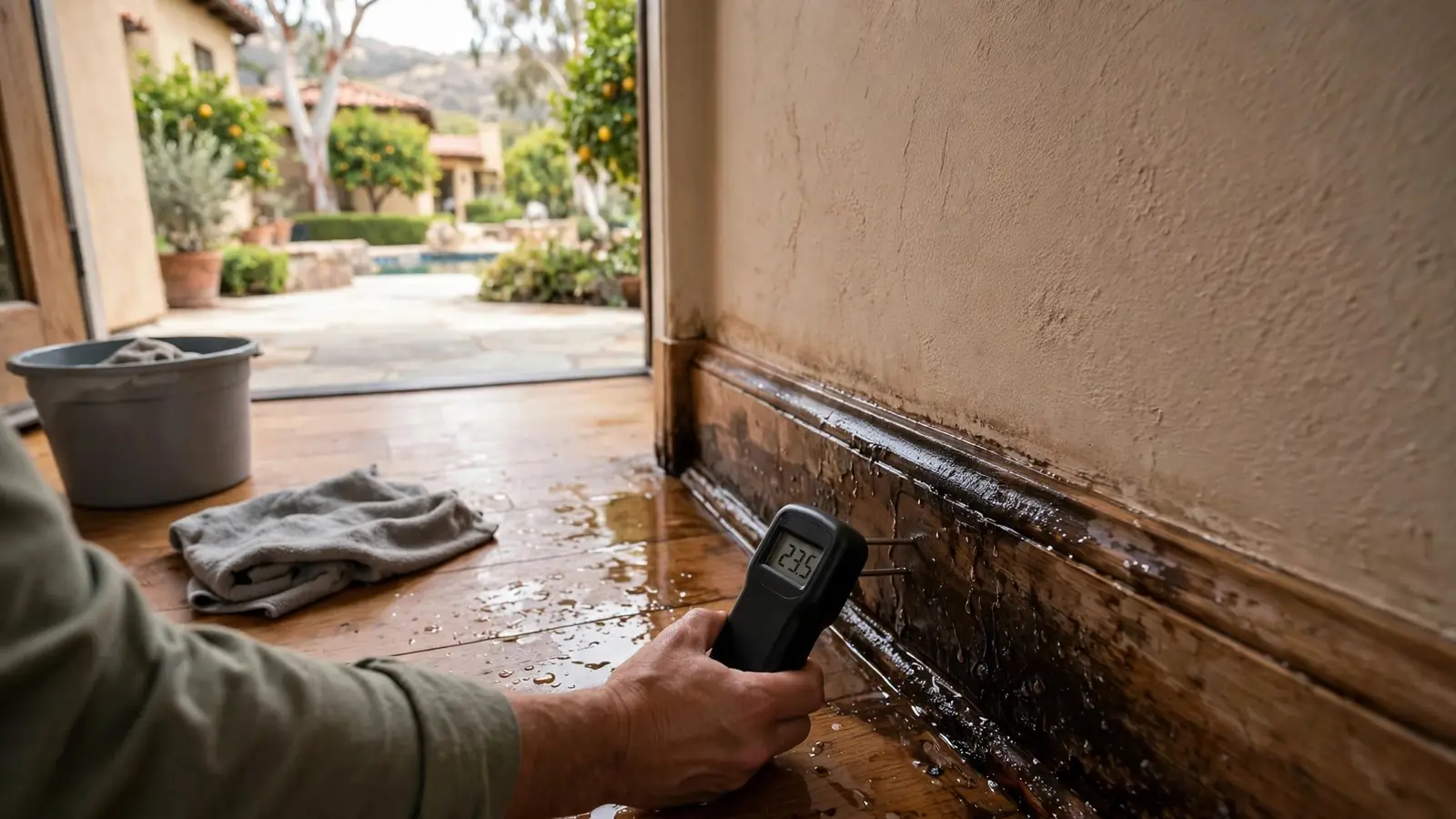
Paint-grade and stained baseboards swell and open at the joints when the drywall behind them is wet. It is often the first sign of a slow supply leak.
Stone that stays dark
Limestone, travertine and some marbles darken as they absorb water and can stay dark for days. A patch that refuses to lighten means moisture is still feeding it.
A musty smell in one room
An earthy odor that appears in a closet, a wine room or behind a built-in usually means water has been sitting long enough for microbial growth to begin.
Bubbled paint or plaster
Blisters on painted walls or a powdery bloom on plaster show water moving through the wall from inside, not just splashing on the surface.
Higher water use with no explanation
A jump in the bill from the Santa Fe Irrigation District or Olivenhain Municipal Water District with no new irrigation can point to a hidden leak under a slab or in a wall. [6] [5]
Why damage spreads
Why the damage keeps growing after the leak stops
Water does not stay where it lands. It wicks up drywall like a paper towel, travels along the top of a concrete slab under flooring, and soaks into the bottom plate of every wall it reaches. A leak that ran for two hours in a second-floor bathroom may have reached the ceiling of the room below, the cavity of the wall beside it and the insulation in the floor framing, even if the only visible sign is a drip from a light fixture.
Time adds a second problem. The U.S. EPA advises that water-damaged materials should be dried within 24 to 48 hours to help prevent mold growth. [1] After that window, the job usually changes from a drying job into one that also includes mold remediation, which brings containment, air filtration and more removal. That is why cleanup is treated as urgent even when the leak itself is fixed.
Large homes make this worse in a quiet way. When a guest wing, pool house or casita is used only a few times a year, a leak can run for days before anyone notices. By the time someone opens the door, water has had time to reach places a weekend leak in a main house would not.
Finally, finishes trap moisture. Sealed stone, thick area rugs, wallpaper and vinyl-backed wall coverings all slow evaporation, so the material underneath stays wet much longer than an open surface would. Part of cleanup is deciding which of these layers has to be lifted or opened to let the structure dry.
Assessment
How a contractor sizes up the damage before removing anything
- 1
Confirm the source is stopped
The main shutoff or the fixture valve is closed, and the contractor checks whether the leak came from supply water, a drain, irrigation or the outside. The source decides the water category.
- 2
Classify the water
Using the IICRC S500 categories, clean supply water (Category 1) is handled differently from water with some contamination (Category 2) or sewage and floodwater (Category 3). [2]
- 3
Map the wet area
Pin and pinless moisture meters, and often a thermal camera, are used to find the edges of the wet zone on floors, walls and ceilings, room by room.
- 4
Check for hazards
Electrical circuits in wet areas, ceilings sagging with trapped water and, in older homes, materials that may contain asbestos or lead paint are identified before any demolition.
- 5
Record everything
Photos, moisture maps and notes on finishes and contents are taken before work begins, so the insurer and the repair team can see the starting point.
- 6
Agree the plan
The contractor explains what will be extracted, what will be dried in place, what has to be removed and how valuable contents will be moved and protected.
Diagnosis
What common water sources usually mean for cleanup
| Source | Usual water category | What it often affects |
|---|---|---|
| Supply line to sink, toilet or fridge | Category 1 if caught quickly | Cabinets, flooring, wall bases and the ceiling below |
| Water heater or softener failure | Category 1, can degrade with time | Garage or mechanical room, adjacent finished walls |
| Dishwasher or washing machine overflow | Category 2 | Kitchen or laundry flooring, cabinet toe-kicks, subfloor |
| Irrigation line or sprinkler against the house | Category 2 | Exterior stucco, sill plates, interior wall bases |
| Roof or window leak in a storm | Category 1 to 2 | Ceilings, window returns, plaster and drapery |
| Toilet or drain backup | Category 3 | Bathroom floors, adjoining rooms, anything porous it touched |
| Water left standing several days | Can become Category 3 | Anything it touched, now with possible microbial growth |
The cleanup process
How cleanup is done in a house full of fine finishes
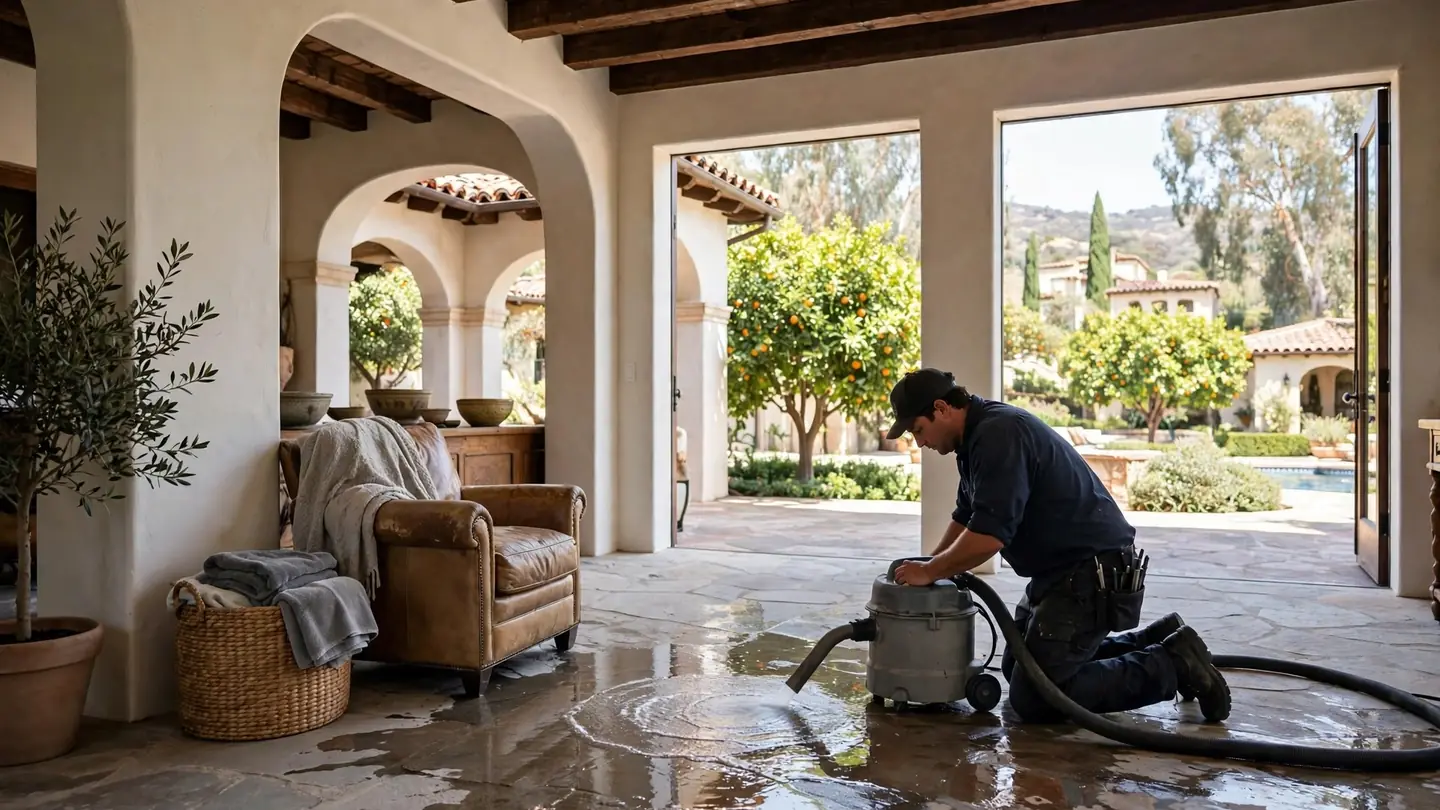
Extraction comes first. Truck-mounted or portable extractors pull water from carpet and pad, and weighted extraction tools squeeze water out of padding without lifting it. On hard surfaces, squeegees and wet vacuums clear standing water before it can seep into grout lines and under baseboards. In a home with a mix of stone, wood and carpet, the order matters: crews usually clear the surfaces that soak water up fastest first.
Next comes controlled removal. Wet carpet pad is almost always discarded because it holds water like a sponge and rarely dries fully before mold becomes a risk. Drywall is cut at a measured height above the wet line, usually in a straight line so the repair is clean. Insulation that has soaked through is pulled. Baseboards and casing are numbered and removed carefully when they are stain-grade or custom profiles, so they can go back in the same place.
Cleaning follows removal. Surfaces that stay are cleaned with a product suited to the water category, and in Category 2 or 3 situations an antimicrobial may be applied to structural materials. Contents that were touched by contaminated water are separated from those that were not.
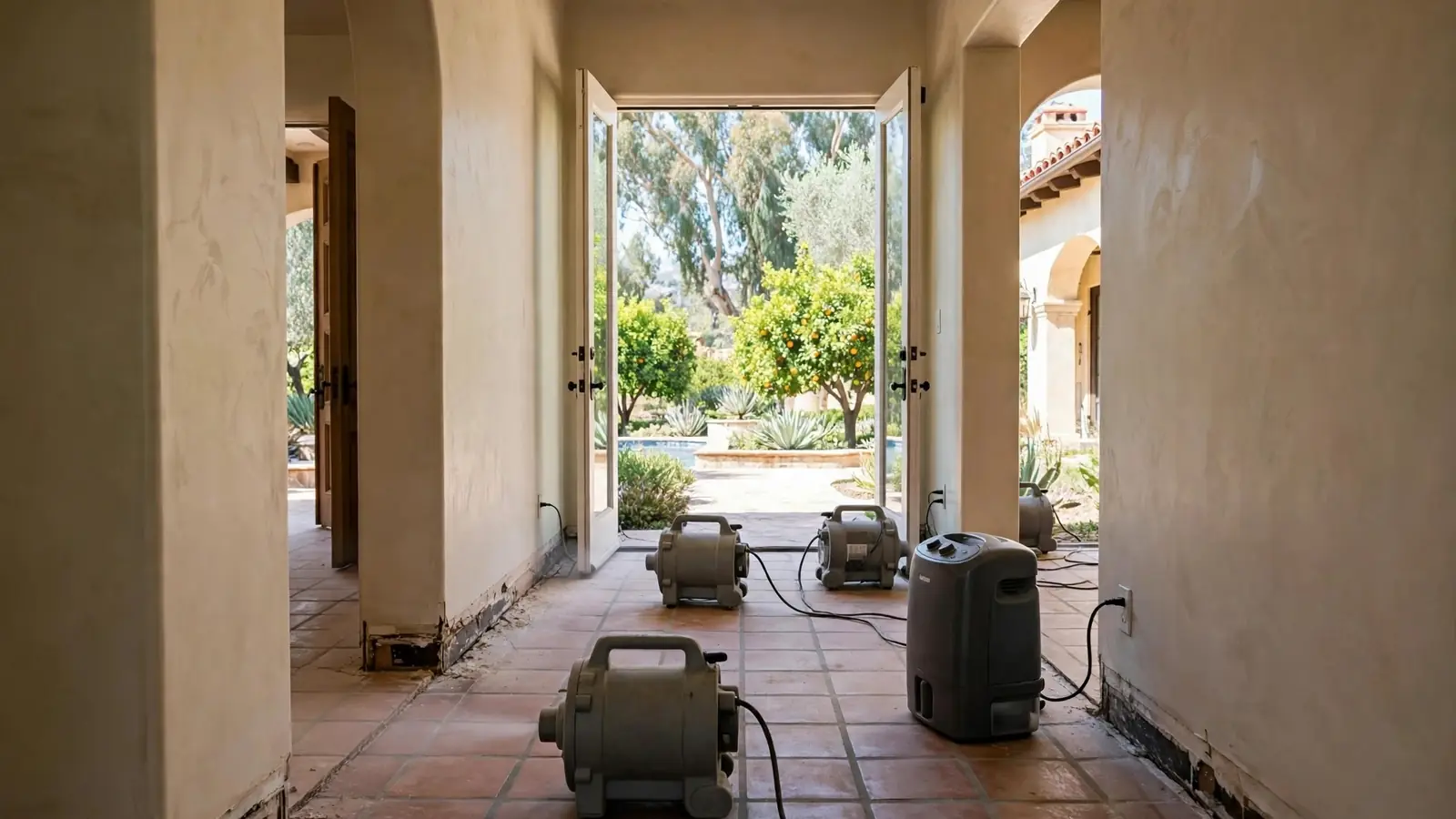
Only then does the drying setup go in: air movers aimed along walls, dehumidifiers sized for the volume of the space, and sometimes floor drying mats or wall cavity injection. The drying phase is covered in depth on our water mitigation and drying page. Cleanup ends when the space is clean, the wet materials are out, and drying is underway with a monitoring plan.
Materials
How common estate finishes are usually handled
| Material | Often dried in place? | Notes |
|---|---|---|
| Site-finished hardwood | Sometimes | Drying mats can save boards caught early; cupping may relax as they dry, then floors are re-sanded |
| Engineered wood over concrete | Rarely | Water under the planks often means lifting a section to dry the slab |
| Limestone or travertine | Usually | Dries slowly; avoid sealing until readings are normal, watch for efflorescence |
| Porcelain tile | Usually | The tile survives; water under it and in the wall behind is the concern |
| Drywall | Category 1 only, if quick | Cut out if soaked, if insulation behind is wet, or if the water was contaminated |
| Lath and plaster | Often | Plaster tolerates water better than drywall but takes much longer to dry |
| Wool or silk area rugs | Specialist cleaning | Move off the wet floor at once; dyes can bleed, so they go to a rug cleaner |
| Custom cabinetry | Sometimes | Toe-kicks and backs can be opened to dry; swollen particleboard boxes may need replacing |
Talk to a local contractor
Questions about water damage cleanup?
One call connects you with an independent water damage restoration contractor who serves Rancho Santa Fe.
Before help arrives
What you can safely do while you wait
Most of the early steps that limit damage are simple and safe. They also make the contractor's job faster when they arrive. The aim is to stop the water, keep people safe and save the things that matter most to you.
Leave the heavier work, such as pulling carpet, cutting walls or moving large furniture across wet floors, to the crew. Wet carpet is very heavy, and wet drywall can hide live wiring.
- Close the fixture valve or the main water shutoff
- Turn off breakers for wet rooms only if the panel is dry and safe to reach
- Lift rugs, art and electronics off wet floors
- Put foil or wood blocks under furniture legs
- Photograph every wet area before anything is moved

The visit
What happens when the cleanup crew arrives
A good first visit starts with a walk-through with you. The lead technician will ask when you first noticed the water, where it came from and what has been done so far. They will look at the source, test the wet area and point out anything that needs your decision, such as whether to move a piano or whether a rug should go to a specialist.
Equipment usually follows the walk-through. Expect extraction gear, hoses that run to a truck or a portable unit, plastic sheeting to protect floors along the work path, and drying equipment that will stay in the house for several days. In a large home with long walking distances, crews often protect a dedicated route from the entrance to the work area.
Before any removal, ask the crew to tell you what is coming out and why. Many homeowners like a quick list of removed items and photos of hidden damage once walls are opened. These are normal requests and help later with insurance and with your own builder.
Before leaving, the crew should explain the monitoring schedule, how loud the equipment will be, which rooms are off limits, and what to do if a breaker trips or a machine stops. Drying equipment draws real power, so in a home with a lot of circuits already in use, the crew may need to spread equipment across circuits.
Rancho Santa Fe specifics
Cleanup in a Rancho Santa Fe estate is a different job
Rancho Santa Fe homes sit on large lots, often an acre or more, with long driveways, gates and sometimes a separate guest house, pool house or barn. That scale changes logistics. Crews may need gate codes or a staff contact, a place to park a truck-mounted unit close enough to run hoses, and a plan for working in one wing while the household carries on in another.
The finishes inside are often custom: imported stone, reclaimed beams, hand-troweled plaster, built-in libraries and wine storage. Many of these cannot simply be ordered again. A careful contractor will treat them as items to save and dry rather than demolish, and will be open about when that is realistic and when it is not.
Water supply is part of the local picture too. Homes here are served by the Santa Fe Irrigation District or the Olivenhain Municipal Water District depending on location. Both supply hard water, and mineral scale on valves, fittings and softener equipment is a common factor in supply-line failures. Knowing where your main shutoff is, and whether it still turns, is worth checking before anything goes wrong.
Repairs that change the outside of a home inside the Covenant can require review through the Rancho Santa Fe Association, and building permits for repairs in this unincorporated area are handled by San Diego County Planning & Development Services. [7] Interior cleanup usually needs neither, but the rebuild that follows sometimes does, so ask early.
Prevention
Reducing the chance of another leak in a large home
Most indoor water damage in large homes comes from a small set of fittings and appliances. A few habits cut the risk sharply.
- Replace rubber supply hoses on washers, sinks and toilets with braided lines and check them every year or two
- Fit automatic shutoff valves or leak sensors in laundry rooms, under sinks, near water heaters and in wine rooms
- Exercise the main shutoff and fixture valves once a year so they turn when you need them
- Keep sprinkler heads aimed away from walls and check irrigation for runoff against the foundation
- Ask staff or a house watcher to open and walk unused wings, casitas and guest houses each week
- Have softener and water heater equipment serviced on schedule, since hard water shortens the life of fittings
Dry or replace
When drying in place is worth it and when removal is smarter
Drying in place saves original materials and avoids the dust and disruption of demolition. It works best with clean water, quick action and materials that tolerate moisture, such as plaster, solid wood framing, stone and tile. If a contractor can show falling moisture readings each day, there is a good case for patience.
Removal is usually the better call when the water was contaminated, when it sat long enough for odor or visible growth, when materials have lost their shape or strength, or when the wet layer is hidden behind something that will not let it dry. Swollen particleboard cabinet boxes, saturated carpet pad and drywall with soaked insulation behind it fall into this group.
For irreplaceable items, such as hand-painted wall finishes, antique flooring or custom millwork, ask about middle-ground options. Sections can sometimes be removed carefully, dried off-site and reinstalled, or a specialist conservator can be brought in. These choices are worth discussing on your first call.
Related problems
Problems that often show up alongside a household leak
Hidden moisture in walls
Water in the wall cavity can stay wet long after the surface looks dry. Our guide on hidden moisture explains how it is found.
Mold growth
If materials stayed wet beyond a day or two, mold can begin. Containment and removal follow the IICRC S520 standard.
Ceiling damage below a bathroom
Second-floor leaks often show up first as stains or drips in the ceiling of the room below.
Slab leaks
A pressurized line under the slab can wet flooring from below without any visible source. Leak detection comes before cleanup.
FAQ
Water damage cleanup questions from Rancho Santa Fe homeowners
How soon should cleanup start?
As soon as possible. Extraction in the first few hours limits how far water spreads, and the EPA advises drying materials within 24 to 48 hours to help prevent mold. The line on this site is answered around the clock.
Can my hardwood floors be saved?
Often, if the water was clean and drying starts quickly. Floor drying mats pull moisture up through the boards. Boards that cupped may flatten as they dry and are then re-sanded and refinished. Engineered planks over concrete are harder to save.
Do I need to move out during cleanup?
Usually not in a large home. Crews can section off affected rooms and work around the household. You may want to avoid sleeping near running equipment, and Category 3 water may mean keeping people out of those rooms.
What happens to my rugs and furniture?
Rugs are lifted off wet floors right away and fine rugs usually go to a specialist cleaner. Furniture is moved, blocked up or wrapped. Ask the contractor for a written list of anything taken off-site.
Is water damage repair part of cleanup?
Repair, meaning new drywall, paint and refinished floors, usually comes after drying is confirmed. Some contractors do both phases; others hand off to a builder. Ask which approach the contractor takes.
Will my insurance cover cleanup?
That depends on your policy and the cause. Sudden and accidental leaks are often covered while long-term seepage often is not. Talk to your insurer early and read our guide to working with an insurance adjuster.
How do I check a contractor's license?
Use the license lookup on the California Contractors State License Board website. [3] Ask for the license number on your call and check that the name matches.
Does calling commit me to anything?
The call connects you with an independent contractor for a conversation. Nothing is agreed unless you and the contractor agree it.
Sources and citations
- [1]U.S. EPA: Mold cleanup in your home
- [2]IICRC S500 Standard for Water Damage Restoration
- [3]California Contractors State License Board
- [4]California Department of Insurance
- [5]Santa Fe Irrigation District
- [6]Olivenhain Municipal Water District
- [7]San Diego County Planning & Development Services
- [8]Rancho Santa Fe Association
- [9]U.S. EPA: Protect your family from asbestos