
Key facts: Fairbanks Ranch
- Fairbanks Ranch is a census-designated place in San Diego County on former ranch land of Douglas Fairbanks and Mary Pickford.
- The community lies in the San Dieguito River valley, lower ground than the surrounding hillside communities.
- Fairbanks Ranch Country Club hosted equestrian events of the 1984 Summer Olympics.
- FEMA's Flood Map Service Center shows mapped flood zones by address, including areas along the San Dieguito River.
- Homes here are largely served by the Santa Fe Irrigation District, which reports hard water.
In this page
- 1Fairbanks Ranch ZIP codes covered
- 2A gated valley community with its own water story
- 3Fairbanks Ranch building features that affect water damage
- 4The usual routes for water damage in Fairbanks Ranch
- 5What a contractor should check in a Fairbanks Ranch home
- 6Fairbanks Ranch water damage clues and likely causes
- 7How restoration usually works in a Fairbanks Ranch estate
- 8Getting crews through the gates in Fairbanks Ranch
- 9Storm season and dry season in Fairbanks Ranch
- 10Practical steps for Fairbanks Ranch homeowners
- 11Restoration services Fairbanks Ranch owners ask about
- 12Slab leaks in large single-story Fairbanks Ranch homes
- 13Homes near the lakes and water features
- 14How the season changes a Fairbanks Ranch water job
- 15Barns and arenas on Fairbanks Ranch lots
- 16A typical first week after water damage in Fairbanks Ranch
- 17Guest houses and detached buildings in Fairbanks Ranch
- 18Questions Fairbanks Ranch homeowners find useful
- 19Attic HVAC equipment in sprawling Fairbanks Ranch homes
- 20Pools, spas and outdoor kitchens on valley-floor lots
- 21Moving and protecting contents across a large floor plan
- 22Aging systems in the first generation of Fairbanks Ranch homes
- 23Fairbanks Ranch water damage questions
Covered area
Fairbanks Ranch ZIP codes covered
Fairbanks Ranch addresses use Rancho Santa Fe ZIP codes. Calls from these ZIPs connect to an independent contractor in our network.
- Rancho Santa Fe ZIP 92067
- Rancho Santa Fe ZIP 92091
About Fairbanks Ranch
A gated valley community with its own water story
Fairbanks Ranch was developed from the early 1980s on the former Rancho Zorro, the ranch Douglas Fairbanks and Mary Pickford owned in the San Dieguito River valley. It is a guard-gated community of large lots, with lakes, riding areas and a country club, and it sits just south and east of the original Rancho Santa Fe covenant area.
Most homes were built from the 1980s onward, many of them large single-story or two-story estates on concrete slabs, with extensive hardscape, pools and landscaping. Architectural styles range widely, from Mediterranean and Spanish revival to contemporary and traditional.
Geography is the defining factor for water damage. The valley floor is lower and flatter than the hillside communities around it. Water from surrounding slopes, the community's lakes and the river corridor all collect on lower ground, and a home's own drainage has less natural fall to work with.
Construction
Fairbanks Ranch building features that affect water damage
Large slab-on-grade footprints
Single-story estates spread across big slabs. Supply lines in or under the slab can leak unseen across a large area.
Wide-plank wood over concrete
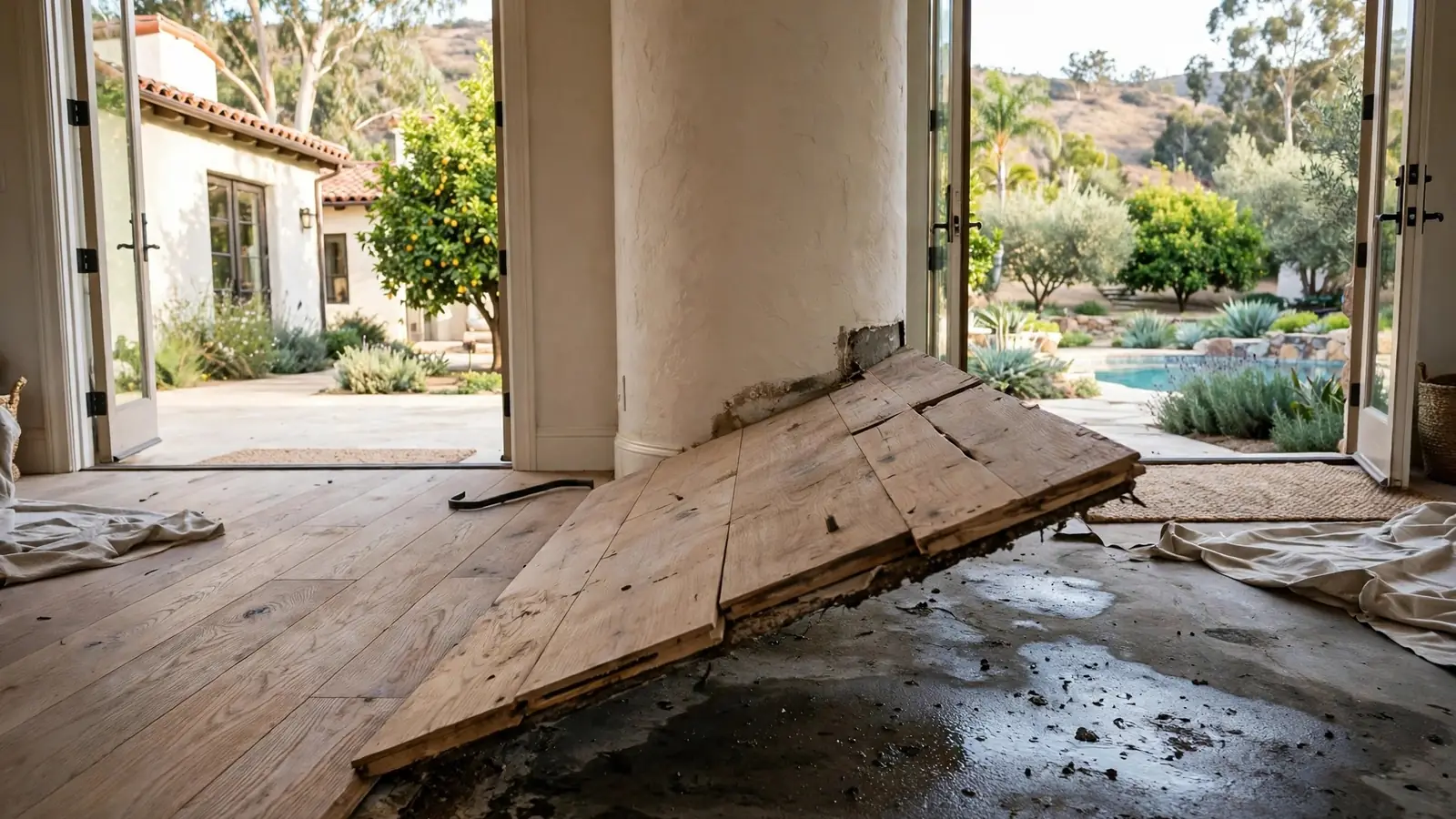
Wood floors over slabs are vulnerable to water from below, whether from a slab leak or rising moisture.
Extensive hardscape and pools
Motor courts, terraces and pool decks send a lot of water to drains during storms.
Lake and waterside lots
Homes near the community's lakes have water features close by and sometimes high groundwater.
Equestrian facilities
Barns, arenas and wash racks add water lines and roof runoff to the property.
Multiple HVAC zones and attic equipment
Large homes often have several air handlers in attics, each with a condensate line that can overflow.
How water gets in
The usual routes for water damage in Fairbanks Ranch
Inside, the most common sources are the same as in any large home: supply lines to fixtures and appliances, water heaters, laundry and HVAC condensate. Because so many homes are on slabs, slab leaks deserve special mention. A pressurized line under the slab can wet the floor from below for some time before anyone notices a warm spot, a sound or a cupped board.
Outside, storm runoff is the main concern. On the valley floor, water from the surrounding slopes collects, and a property's own drains may have a shallow fall to work with. Courtyards and terraces that drain toward the house, blocked inlets and overflowing pool decks can send water under doors.
Irrigation is a quieter source. Large lawns, gardens and equestrian areas use a lot of water. A broken lateral near the house or sprinklers aimed at a wall can wet the foundation and wall bases over weeks.
Assessment
What a contractor should check in a Fairbanks Ranch home
- 1
Rule out a slab leak
If water appears with no obvious source, check the meter with all water off. A moving meter points to a pressurized leak.
- 2
Check the drainage path in storms
Where water entered tells the contractor whether drains, grading or a door threshold failed.
- 3
Map moisture across the slab
On large slabs, water can spread far under flooring. Readings across adjacent rooms show its extent.
- 4
Look at attic equipment
Ceiling stains often come from air handler condensate. Pans and drain lines are checked.
- 5
Check the flood zone
If the home is near the river corridor or a lake, the FEMA flood map helps explain risk and coverage.
- 6
Document for insurance
Photos, moisture maps and notes on the cause are essential, especially if flood and non-flood water are both involved.
What you might see
Fairbanks Ranch water damage clues and likely causes
| Sign | Likely cause | First step |
|---|---|---|
| Warm spot on a tile or wood floor | Hot water line leaking under the slab | Leak detection, then slab drying |
| Wood floor cupping across a room | Moisture from the slab below | Find the source; lift boards if needed |
| Water under patio doors after rain | Blocked drain or terrace sloping to house | Clear drain, protect threshold |
| Ceiling stain near a vent | Air handler condensate overflow | Check pan and drain line in the attic |
| Wet wall base on the garden side | Irrigation spray or broken lateral | Adjust or repair irrigation |
| Water across the lowest floor in a big storm | Surface or valley flooding | Treat as Category 3; check flood coverage |
Restoration approach
How restoration usually works in a Fairbanks Ranch estate
Drying slab homes is mostly about the slab. Once water gets under flooring, the concrete absorbs it and releases it slowly. Tile can often stay, with dehumidification and air movement working on grout lines and edges. Wood over concrete is harder: floor drying mats can work when caught early, but often some boards need lifting so the slab can breathe.
Because these homes are large, contractors size dehumidification for the affected volume and often section off wings with plastic to concentrate drying. Expect monitoring visits over a week or more when a slab is involved.
If storm water came in from outside, it is treated as Category 3, and porous materials it touched, such as carpet, pad and drywall bases, usually come out. [7] Tile, stone and framing are cleaned and treated before drying.
Repairs follow drying. Wide-plank wood floors may need refinishing across a whole room to blend in; stone and tile may need matching. Product details from the original build help.
Gates and access
Getting crews through the gates in Fairbanks Ranch
Fairbanks Ranch is guard-gated, so crews need to be expected at the gate. Let the gatehouse know a restoration contractor is coming, or give the contractor the details they need, so equipment is not held up.
Inside, long drives and large lots usually make parking easy, but tell the contractor which entrance is closest to the damage and whether there are animals or staff on site.
- Notify the gatehouse in advance
- Give the contractor your name and street for the gate
- Point out the closest entrance to the damage
- Mention pets, horses and staff

Seasonal factors
Storm season and dry season in Fairbanks Ranch
Rain in coastal San Diego County is concentrated in a few months, usually from late fall to early spring. Atmospheric river storms can bring heavy rain over a short period, and the National Weather Service in San Diego issues flood watches when they are expected. [6] On the valley floor, that is when drainage gets tested.
The long dry season brings heavy irrigation and pool use, and that is when irrigation leaks, pool equipment leaks and AC condensate problems are most likely. Indoor plumbing failures happen year-round.
Prevention
Practical steps for Fairbanks Ranch homeowners
- Have area drains, channel drains and courtyard inlets cleaned and tested before the rainy season
- Know your flood zone and review flood coverage with your agent
- Fit automatic leak shutoffs, especially in slab homes where leaks hide
- Check attic air handler pans and condensate lines each summer
- Keep irrigation spray off walls and check for wet spots near the foundation
- Watch the water bill for unexplained increases that could mean a slab leak
Services
Restoration services Fairbanks Ranch owners ask about
Flood cleanup
Storm and runoff water entering low-lying homes, handled as contaminated water.
Mitigation and drying
Slab and wood floor drying measured over days, not guessed.
Water damage cleanup
Supply leaks, appliance failures and condensate overflows in large homes.
Sewage cleanup
Backups in homes with many bathrooms, guest quarters and long drain runs.
Slab leaks in depth
Slab leaks in large single-story Fairbanks Ranch homes
Slab leaks are a particular concern in large single-story homes, because so much plumbing runs under or within the slab. Hot water lines are often the first to fail, since heat and pressure cycles stress them. Signs include a warm floor, the sound of running water, a water heater that runs constantly, and a meter that moves with everything off.
Finding a slab leak is a job for a leak detection specialist using acoustic and pressure tools. Once found, a plumber decides whether to repair through the slab or reroute the line through walls or the attic. Rerouting avoids breaking the slab but changes where future leaks can happen.
The restoration side focuses on drying the slab and the flooring above it. That can take time, and lifting some flooring is often the fastest route to a dry slab.
Talk to a local contractor
Questions about fairbanks ranch?
One call connects you with an independent water damage restoration contractor who serves Rancho Santa Fe.
Lakes and water features
Homes near the lakes and water features
The community's lakes are a defining feature, and homes near them have water close at hand. Groundwater can be higher on low lots, and any below-grade spaces or very low thresholds deserve attention. Landscape water features, fountains and pools on individual properties add more lines and equipment.
If water appears inside a lakeside home with no obvious plumbing cause, ask whether groundwater or drainage could be involved. The answer affects both cleanup and insurance.
Seasonal timing
How the season changes a Fairbanks Ranch water job
| Time of year | Typical causes | What to expect |
|---|---|---|
| Late fall to early spring | Storm runoff, drains, roof leaks | Possible Category 3 water; drainage checks |
| Spring | Plumbing, irrigation start-up | Good drying conditions |
| Summer | AC condensate, pool equipment, irrigation | Warm drying; attic checks |
| Fall | Plumbing, first-storm drain blockages | Pre-season drain cleaning helps |
Equestrian properties
Barns and arenas on Fairbanks Ranch lots
Equestrian use has been part of Fairbanks Ranch since its founding, and the country club hosted Olympic equestrian events in 1984. Private barns, arenas and paddocks add water lines, wash racks and large roof areas. Barn offices and tack rooms can be damaged by a stuck waterer or a storm leak.
Restoration in barns means working around animals and feed. Wet feed and bedding are usually discarded. Leather tack is dried slowly. Let the contractor know about animals on the call.
Week one
A typical first week after water damage in Fairbanks Ranch
- 1
Day one
Source stopped, extraction done, moisture mapped across the slab, drying started.
- 2
Day two
Any flooring that must be lifted is lifted; leak detection scheduled if a slab leak is suspected.
- 3
Days three to five
Monitoring visits; dehumidifiers and air movers adjusted; slab readings tracked.
- 4
Days five to ten
Slab and wood areas continue to dry; equipment removed from finished areas.
- 5
After drying
Plumbing repair or reroute finished; floors refinished or replaced; repairs completed.
Guest houses
Guest houses and detached buildings in Fairbanks Ranch
Many Fairbanks Ranch estates include guest houses, pool houses or staff quarters. These have their own plumbing and sometimes their own water heaters, and they are often empty for weeks. A leak can run unseen for a long time.
If water is found in a detached building, mention how long it may have been unused. Longer-standing water changes the scope and may require mold checks as well as drying.
On your call
Questions Fairbanks Ranch homeowners find useful
- How do you dry a slab under tile or wood?
- Do you work with leak detection specialists for slab leaks?
- How do you handle storm water versus a plumbing leak?
- Can you coordinate with the gatehouse?
- How will you protect floors along the work path in a large home?
- What is your California contractor license number?
Attic air handlers
Attic HVAC equipment in sprawling Fairbanks Ranch homes
A large single-story home cannot be conditioned by one system, so many Fairbanks Ranch estates have several air handlers, often in the attic above bedrooms and living areas. Each produces condensate whenever it cools, and each relies on a primary drain line and a secondary pan to carry that water away. When a line clogs with algae or a pan rusts through, water drips onto the ceiling below.
The first sign is usually a stain near a supply register or along a hallway ceiling, most often in summer when air conditioning runs hardest. Drywall ceilings soak up the water and can sag. A technician will check the pan, clear the line and dry the ceiling cavity, sometimes through small openings rather than removing the whole ceiling.
A float switch that shuts the unit off when the pan fills is a simple safeguard. Ask your HVAC service company whether each air handler has one, and have the drain lines flushed during routine maintenance.
Pools and outdoor living
Pools, spas and outdoor kitchens on valley-floor lots
Outdoor living areas are a big part of most Fairbanks Ranch properties: pools, spas, fountains, outdoor kitchens and covered loggias. Each has water lines running underground and equipment that can leak. Pool equipment pads are often close to the house, and a failed fitting can send water toward a wall base or into a garage.
On flat lots, pool decks that drain toward the house are a recurring problem in storms, especially when a pool is full to the tile line and rain adds more. Deck drains clogged with leaves make it worse. Keeping deck drains clear and the pool level managed before a big storm helps protect the rooms facing the pool.
If water appears in a room next to the pool, ask the contractor to check the deck drainage and the equipment area as possible sources before assuming it is plumbing inside the house.
Contents in large homes
Moving and protecting contents across a large floor plan
Single-story estates put a lot of furniture, rugs and art on the same level as the water. When a slab leak or storm water spreads under flooring, contents in several rooms can be at risk at once. Moving furniture off wet floors, lifting rugs and taking art off lower walls are among the first tasks.
In a big house it helps to name a dry room where contents can be staged, and to ask the crew to photograph and list what they move. That keeps the record clear for insurance and makes putting the house back together much easier.
Homes from the 1980s
Aging systems in the first generation of Fairbanks Ranch homes
The earliest Fairbanks Ranch homes are now around forty years old, and many of their original systems are reaching the end of their service life. Water heaters, supply valves, fixture connections, roof underlayment and some original copper or early plastic piping may be due for replacement even where the house has been updated cosmetically.
Homeowners preparing for a major remodel sometimes find that a long-hidden slow leak has been feeding a wall or floor for years. If you are planning renovation work, a plumbing inspection and a moisture survey of suspect areas before work begins can save surprises later.
For homes that have changed hands, ask the previous owner or your inspector what has been replaced and when. Knowing the age of the main components makes it easier to set priorities for preventive work.
FAQ
Fairbanks Ranch water damage questions
Is Fairbanks Ranch in a flood zone?
Some parts of the San Dieguito River valley are mapped flood zones. Check your address on the FEMA Flood Map Service Center.
Can wood floors over a slab be saved?
Sometimes, if caught early with floor drying mats. Often a few boards are lifted so the slab can dry.
How do I know if I have a slab leak?
Turn off all water and watch the meter. If it moves, there is a leak. Warm floors or running-water sounds are other clues.
Does homeowners insurance cover storm flooding?
Standard policies generally exclude flood. Check your policy and ask about separate flood coverage.
Will the contractor need gate access?
Yes. Let the gatehouse know a contractor is coming, or arrange access on your call.
Can I get help in the middle of the night?
Yes. A Fairbanks Ranch caller reaches an independent contractor at any hour, including weekends and holidays.
Who issues permits for repairs?
San Diego County Planning & Development Services handles building permits in this unincorporated area. [9]
Why is my wood floor cupping weeks after a leak?
Moisture from the slab below is still moving into the wood. The slab needs drying before the floor settles.
Is runoff water dangerous?
It is treated as contaminated (Category 3) because it can carry soil organisms, waste and chemicals.
Should I lift a wet rug myself?
Yes, if it is safe. Lift rugs off wet floors quickly, keep fine rugs flat and send them to a specialist cleaner, since dyes can bleed onto stone or wood.
Can I keep living in the house during slab drying?
Usually yes. Drying equipment runs in the affected rooms, and the rest of a large home can stay in normal use. Expect noise near the work area.
How long does slab drying take?
Often a week or more, sometimes longer. The contractor should track readings until they match dry areas.
Sources and citations
- [1]Wikipedia: Fairbanks Ranch, California
- [2]Wikipedia: San Dieguito River
- [3]FEMA: Flood maps
- [4]FloodSmart (National Flood Insurance Program)
- [5]Santa Fe Irrigation District
- [6]National Weather Service San Diego
- [7]IICRC S500 Standard for Water Damage Restoration
- [8]U.S. EPA: Mold cleanup in your home
- [9]San Diego County Planning & Development Services
- [10]California Department of Insurance