Key facts: First Hour After Water Damage
- Stopping the water at the fixture valve or the main shutoff is always the first step.
- Electricity and standing water are a dangerous mix; only touch the panel if it is dry and safe to reach.
- Photos taken before anything is moved help with insurance and with the restoration plan.
- Every hour counts: the EPA's guidance is to get water-damaged materials dry within 24 to 48 hours.
In this guide
- 1Start by stopping the water
- 2Make the house safe before you go further
- 3Record and protect
- 4Make the calls in the right order
- 5Helpful first steps and common mistakes
- 6Prepare for the crew
- 7Things that are specific to homes here
- 8Deciding what to move first
- 9If you are away when the water is found
- 10First-hour questions
Minute one
Start by stopping the water
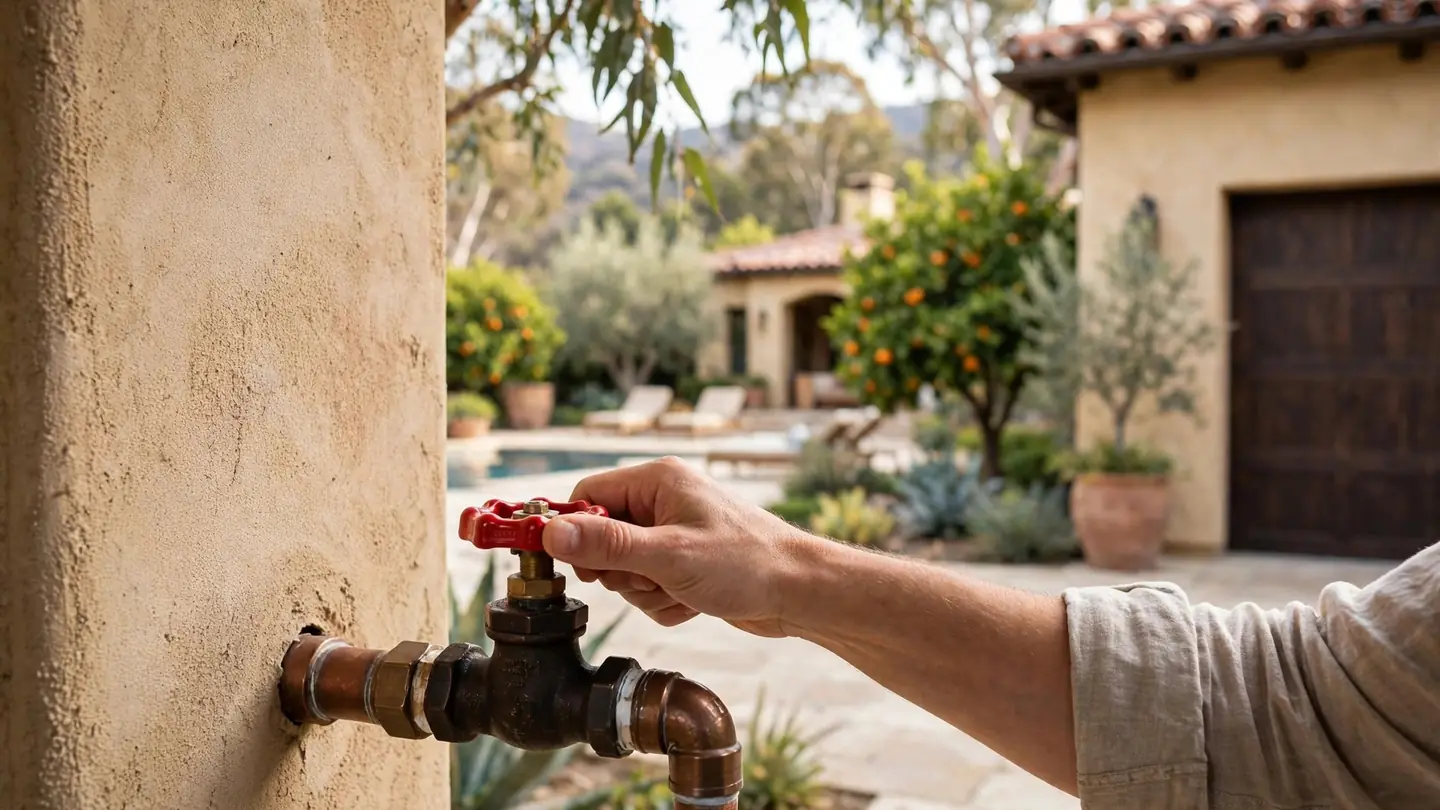
Everything else waits until the water stops. If the source is obvious, such as a toilet, a sink or an appliance, close the small valve on the supply line behind or below it by turning it clockwise. If you cannot find the source, or the fixture valve will not turn, go to the main shutoff for the house.
In many Rancho Santa Fe homes the main shutoff is near where the water line enters the house, often in the garage, a utility area or an exterior wall facing the street or driveway, and there may also be a valve at the meter near the property line. Large homes sometimes have separate shutoffs for guest houses, pool equipment and irrigation. If you do not know where yours are, this is the moment to find out, and afterward to label them.
Safety check
Make the house safe before you go further
- If water is near outlets, cords or appliances, do not walk through it
- Turn off breakers for the wet area only if the panel is in a dry place and you can reach it without standing in water
- If a ceiling is bulging, keep everyone out of the room below; it can come down suddenly
- If the water smells of sewage or came from outside, avoid touching it and keep children and pets away
- If you smell gas or the water heater is damaged, leave and call the gas utility from outside

Minutes five to twenty
Record and protect
- 1
Take photos and video
Walk the wet area and photograph floors, walls, ceilings, the source and anything damaged. Include wide shots and close-ups.
- 2
Lift what matters most
Move rugs, art, documents, electronics and anything irreplaceable to a dry room. Roll rugs rather than dragging them.
- 3
Block up furniture
Put foil, plastic lids or wood blocks under the legs of furniture that cannot be moved, so wood does not wick water and stains do not transfer.
- 4
Mop and blot what you can
On hard floors, soak up surface water with towels or a wet vacuum if it is clean water and safe to do so.
- 5
Open cabinet doors
Opening cabinets under sinks and in kitchens lets air reach wet cabinet bases.
Minutes twenty to forty
Make the calls in the right order
Once the water is stopped and you have photos, make two calls. The first is to a restoration contractor, because drying should start as early as possible. Calling this line connects you with an independent local contractor who can talk through extraction, drying and timing on that same call. The line is answered around the clock.
The second is to your insurer or agent to report the loss. You do not need an adjuster's visit before emergency steps to prevent further damage; most policies expect you to take reasonable action. Ask how they want the claim reported and what documentation they need. Our guide to working with your insurance adjuster has more on this.
What to do and avoid
Helpful first steps and common mistakes
| Do | Avoid |
|---|---|
| Close the nearest valve or the main shutoff | Waiting to see if the leak stops on its own |
| Photograph before moving things | Throwing damaged items away before they are documented |
| Move rugs and valuables to dry rooms | Laying wet rugs over furniture or railings where dyes can bleed |
| Use towels and a wet vacuum on clean water | Using a household vacuum on any water |
| Keep people out of sewage or floodwater | Running household fans over contaminated water |
| Call a contractor and your insurer | Starting demolition before the area is assessed |
Call about this problem
Questions about first hour after water damage?
One call connects you with an independent water damage restoration contractor who serves Rancho Santa Fe.
Minutes forty to sixty
Prepare for the crew
Before the crew arrives, think about access. Large properties may have gates, long driveways and several entrances. Let the contractor know the gate code or arrange for someone to let them in, and clear a path from the nearest door to the wet area. If a truck-mounted extractor will be used, a parking spot close to the house helps.
Gather information the crew will ask for: when you found the water, what you think caused it, what you have already done, and whether anyone in the home has health concerns. If the leak came from a known fixture or appliance, keep the failed part if you can; it can matter for the insurance claim.
Finally, take care of yourself and your household. Water damage feels urgent, and it is, but once the source is stopped and help is on the way, the worst of the first hour is over.
Rancho Santa Fe notes
Things that are specific to homes here
Large homes with guest houses, casitas and pool houses mean water can go unnoticed in a building nobody uses daily. If you find water in one of these, assume it may have been there for a while, and mention that on your call.
Homes are supplied by the Santa Fe Irrigation District or the Olivenhain Municipal Water District depending on location. [6] [5] If you cannot close your own valve, the water district may be able to help shut off at the meter. Both districts post contact information on their websites, and it is worth storing that number in your phone before you need it.
Contents
Deciding what to move first
In a home full of art, books and heirlooms, it is easy to freeze up over what to rescue. A simple rule helps: move what is irreplaceable and what absorbs water fastest. Paper, photographs, textiles and rugs soak up water quickly and are hard to recover. Stone, metal and glass can wait. Electronics should be unplugged at a dry outlet before they are moved, and anything heavy should wait for the crew.
Staff and house watchers
If you are away when the water is found
Many owners are traveling when a house manager, housekeeper or neighbor discovers a leak. Agree in advance who may shut off water, who may let a contractor in, and who should be called. Give them a short written note with the shutoff locations, the gate code arrangements and the insurer's claim line. When everyone knows the plan, the first hour runs the same way whether you are home or not.
FAQ
First-hour questions
Should I turn off the main water even if I found the leak?
If the fixture valve works, that is enough. If it does not turn or keeps dripping, close the main.
Can I use my vacuum on the water?
Only a wet vacuum made for water, and only on clean water. Household vacuums are not designed for water and are an electrical hazard.
Should I wait for my insurer before calling a contractor?
No. Insurers generally expect you to take reasonable steps to prevent further damage. Report the claim promptly and keep records.
Is someone available at night?
Yes. Calls to this line are answered around the clock and connect you with an independent contractor.