Key facts: Rancho Santa Fe Village
- Rancho Santa Fe's village center was planned in the 1920s, with many early buildings designed by Lilian Rice in the Spanish Colonial Revival style.
- Older buildings may contain lead-based paint or asbestos-containing materials that must be tested before demolition.
- Plaster and masonry tolerate water better than drywall but dry much more slowly.
- Exterior changes inside the Covenant, which includes the village, generally require Rancho Santa Fe Association review.
- Building permits in unincorporated Rancho Santa Fe come from San Diego County Planning & Development Services.
In this page
- 1Village addresses served by this line
- 2A 1920s village center that still works every day
- 3Village building features that affect water damage
- 4Where water damage usually starts in the village
- 5What a contractor should check in a village building
- 6Village water damage clues and likely causes
- 7How restoration works in older village buildings
- 8Access and parking on village streets
- 9Rain, leaves and the seasons in the village
- 10Practical steps for village owners and tenants
- 11Restoration services village owners and tenants ask about
- 12Protecting stock, art and records
- 13Homes and cottages close to the village
- 14How the season affects a village water job
- 15When a leak crosses into the shop next door
- 16A typical first week after a village water loss
- 17Water damage in village restaurants
- 18Questions village owners and tenants find useful
- 19Damp at the base of old masonry walls
- 20Drainage in courtyards, arcades and walkways
- 21How original finishes are recorded and matched
- 22Libraries, offices and community spaces
- 23Why humidity matters as much as water in a gallery
- 24Second-floor offices and apartments above shops
- 25Who usually handles what in a village building
- 26Water heaters and mechanical spaces in small buildings
- 27Business records that support a claim
- 28Rancho Santa Fe Village water damage questions
Covered area
Village addresses served by this line
The village and its surrounding streets use the Rancho Santa Fe 92067 ZIP code, which is covered by the contractor network this line connects to.
- Rancho Santa Fe ZIP 92067, including the village center and nearby streets
About the village
A 1920s village center that still works every day
When Rancho Santa Fe was planned, the developers wanted a small village at its center rather than a town. Lilian Rice, one of the first women to graduate in architecture from the University of California, Berkeley, shaped much of its early look. [2] Her buildings and those that followed share a Spanish Colonial Revival vocabulary: thick walls finished in plaster, clay tile roofs, exposed wood beams, arcades and courtyards.
Nearly a century later, the village is still in daily use. Its buildings hold shops, galleries, real estate and professional offices, banks, restaurants and community services. Some of the earliest structures have been carefully preserved; others have been altered or rebuilt in sympathy with the original style. Homes and cottages, some of them early, sit on the streets just beyond the commercial core.
That mix of age, construction and use makes water damage in the village distinctive. A leak can affect a historic wall, a tenant's business and a landlord's building all at once, and the repair has to respect how the building looks.
Construction
Village building features that affect water damage
Thick plaster walls
Plaster over masonry or wood lath absorbs water slowly and dries slowly, but often survives leaks that ruin drywall.
Clay tile roofs and flat sections
Old tile roofs and flat roofs behind parapets depend on underlayment and drains that age.
Arcades and courtyards
Covered walkways and courtyards collect water that must drain away from doors and walls.
Wood beams and ceilings
Exposed beams and board ceilings stain easily and are hard to match.
Mixed old and new plumbing
Generations of upgrades leave a mix of pipe materials and connections.
Ground-level shopfronts
Doors at street level can take in water from courtyards and walkways during heavy rain.
How leaks start here
Where water damage usually starts in the village
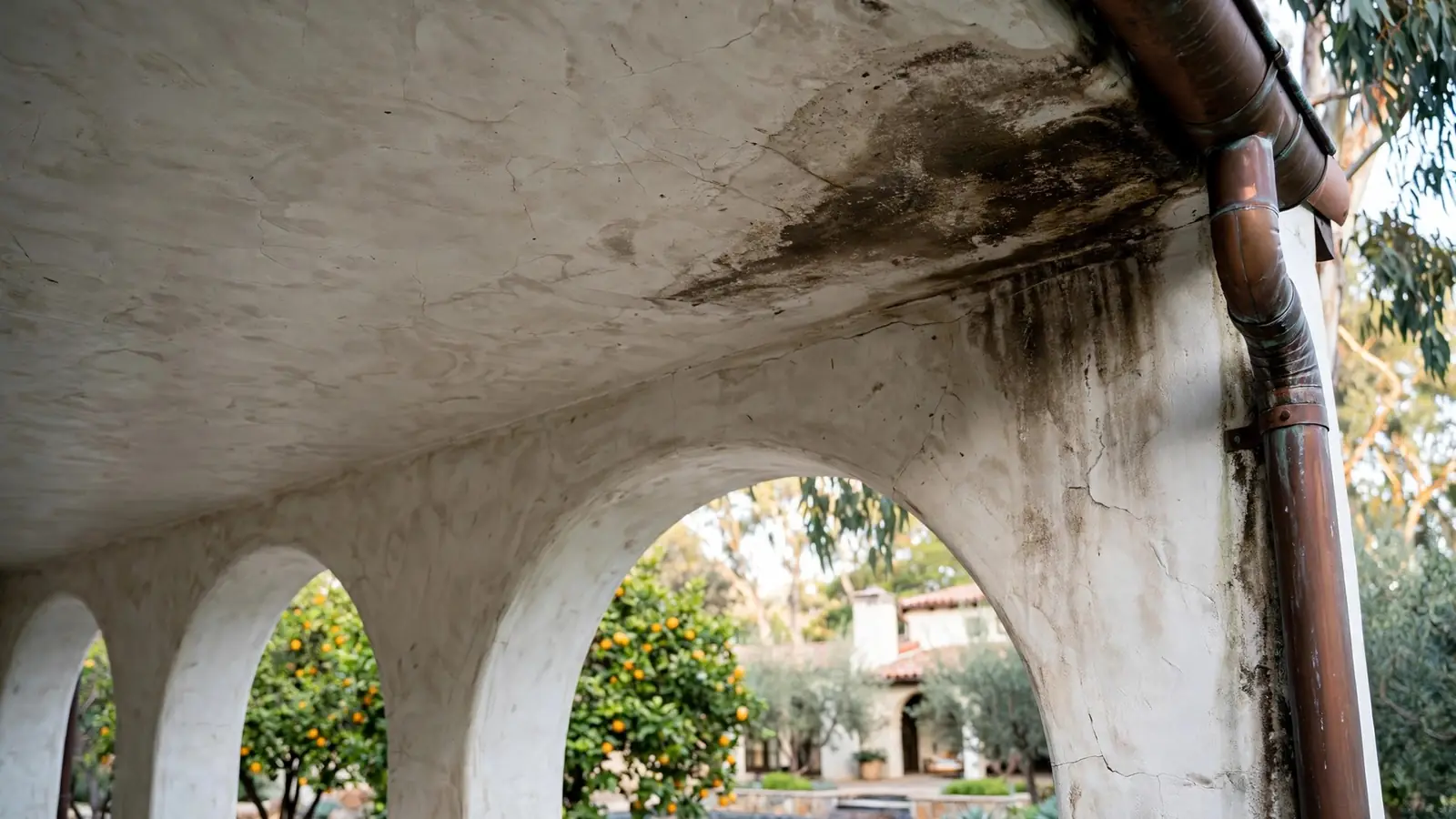
Roofs are a frequent source. Clay tile itself lasts a long time, but the underlayment beneath it does not, and flat roofs behind parapets depend on drains and scuppers that clog with leaves. In heavy rain, water can back up behind a parapet and find a way into walls and ceilings.
Plumbing is the other big source. Restaurant kitchens, restrooms, salon sinks and office kitchenettes all add fixtures to buildings that were not originally designed for them. Connections between new and old pipe, and old pipe itself, are common failure points.
At ground level, courtyards and arcades collect rainwater. If drains are blocked or paving slopes the wrong way, water can run under shop doors. And the eucalyptus that shade the village drop leaves into every gutter and drain.
Assessment
What a contractor should check in a village building
- 1
Confirm who to work with
Owner, tenant and any property manager are identified, and who can authorize work is agreed.
- 2
Stop the source
Supply valves closed, roof drains cleared or temporarily protected, and the cause traced.
- 3
Test before demolition
Older buildings may contain lead paint or asbestos; testing comes before cutting. [6]
- 4
Map moisture in plaster and floors
Readings at plaster bases, tile floors and wood show how far water spread.
- 5
Check neighboring spaces
Village buildings often share walls; adjoining shops or offices are checked.
- 6
Document historic features
Photos and notes on plaster, tile, beams and trim help with matching and any review.
What you might see
Village water damage clues and likely causes
| Sign | Likely cause | First step |
|---|---|---|
| Stain along a beamed ceiling after rain | Roof underlayment or parapet drain | Clear drains; protect roof |
| Plaster bubbling at the base of a wall | Plumbing leak or rising damp from outside | Find source; dry slowly |
| Water under a shopfront door in a storm | Courtyard or walkway drainage | Clear drains; protect threshold |
| Ceiling drip in a back office | Restroom or kitchenette above or beside | Shut supply; trace leak |
| Musty smell in a storeroom | Slow leak or poor airflow | Moisture survey |
| Stain in an arcade ceiling | Clogged downspout or roof edge | Clear and repair drainage |
Restoration approach
How restoration works in older village buildings
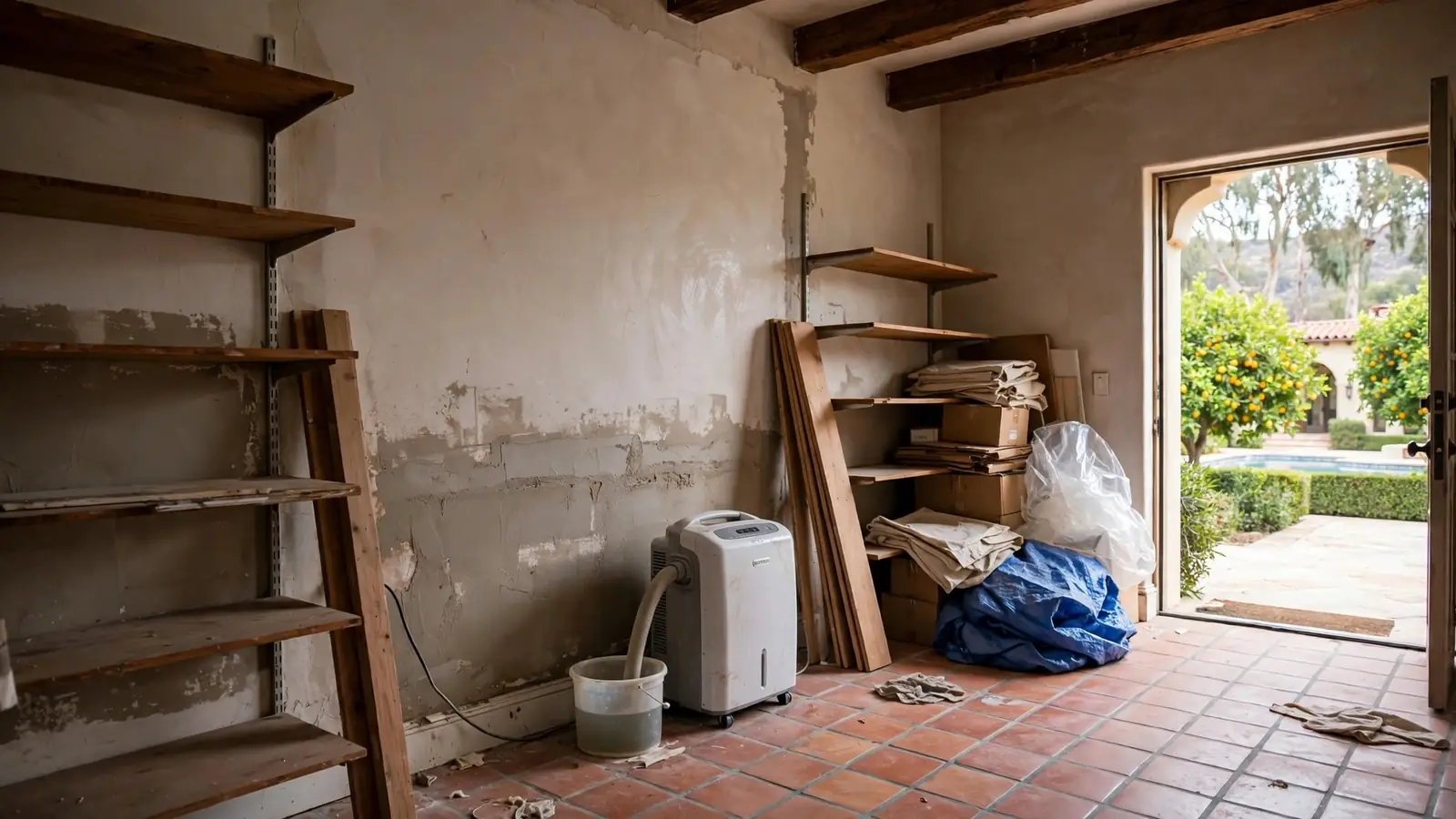
In older buildings, the approach leans toward drying original materials in place. Plaster over masonry can usually be dried if the water was clean and work starts promptly, though it takes longer than drywall. Rushing it with too much heat can crack it. Contractors familiar with historic buildings will set up gentle, steady drying and monitor closely.
Where materials must come out, they are removed carefully and documented so that the repair can match. Trim is numbered, tile is lifted in reusable sections where possible, and plaster is cut cleanly.
In commercial spaces, work is phased to keep businesses open. Containment and air filtration protect customers and staff. Noisy work can be scheduled outside business hours.
Repairs that change a building's exterior generally go through Rancho Santa Fe Association review, and permits come from San Diego County. [3] Interior drying and cleanup usually need neither.
Working in the village
Access and parking on village streets
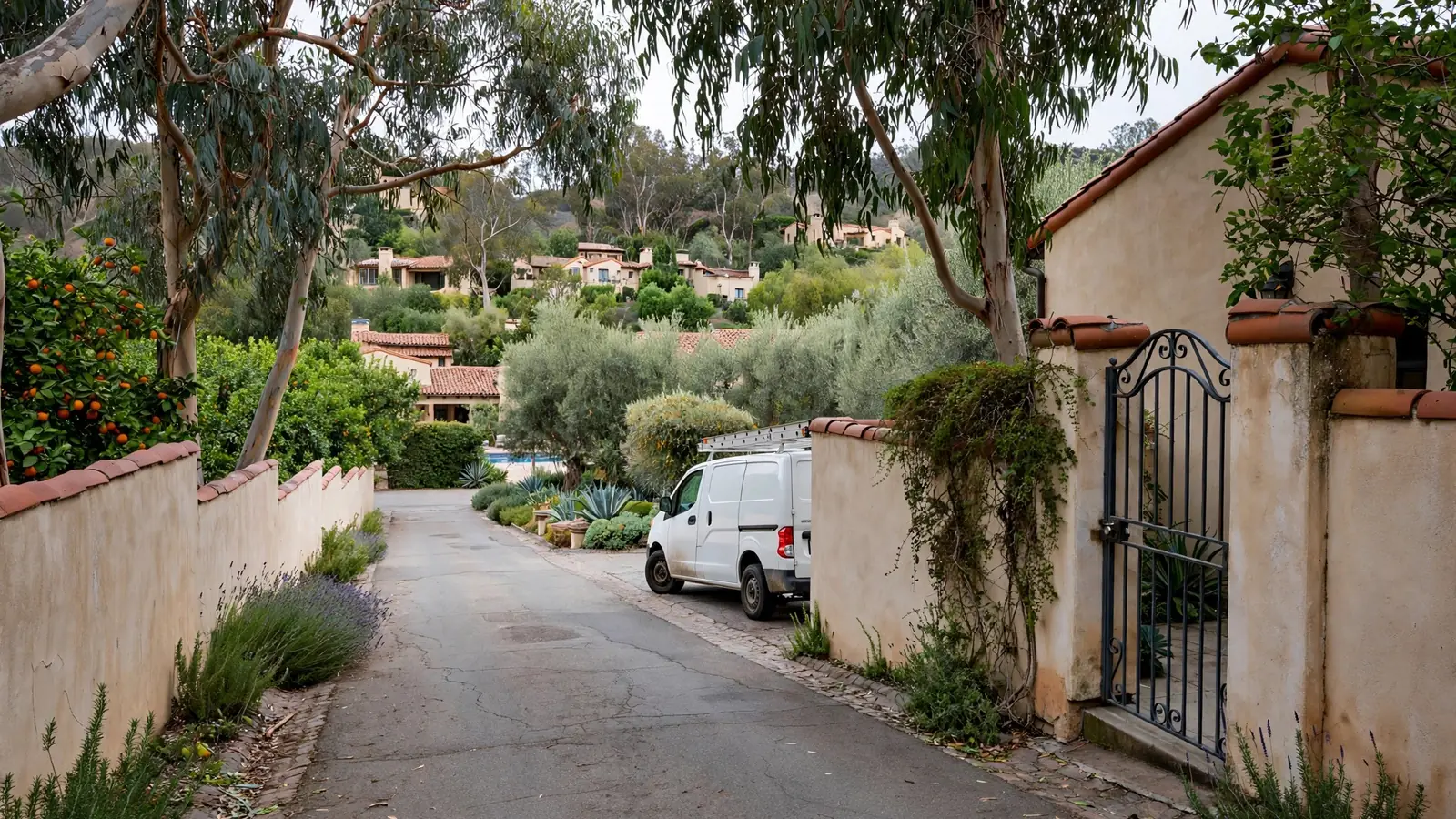
Village streets are small and busy with shoppers, diners and deliveries. Crews need a plan for parking, equipment access and protecting walkways.
On your call, mention the address, the nearest access to the affected space, business hours and any restrictions from the landlord or neighbors.
- Describe the closest access to the affected space
- Mention business hours and quiet times
- Note any landlord or neighbor restrictions
- Say whether customers will be present
Seasonal factors
Rain, leaves and the seasons in the village
Most rain falls from late fall to early spring. The first big storm after months of leaf fall is the riskiest, because drains and scuppers are often full. Atmospheric river storms can deliver a lot of rain quickly, testing old roofs and courtyard drainage.
The dry months bring their own issues: air conditioning condensate in offices and shops, irrigation of planters and landscaping, and heavy use of restaurant kitchens. Plumbing leaks happen year-round.
Prevention
Practical steps for village owners and tenants
- Clear roof drains, scuppers, gutters and courtyard drains before and during the rainy season
- Have roof underlayment and flashing inspected on older buildings
- Fit leak sensors in restrooms, kitchens and storerooms
- Make sure staff know where water shutoffs are
- Keep stock and records off the floor in storerooms
- Share emergency contacts between owners and tenants
Services
Restoration services village owners and tenants ask about
Commercial water damage
Shops, offices and restaurants, phased to keep businesses running.
Mitigation and drying
Patient drying of plaster, masonry, tile and old wood.
Water damage cleanup
Plumbing and roof leaks in older buildings and nearby homes.
Sewage cleanup
Restroom and kitchen backups, handled as Category 3. [7]
Shops and galleries
Protecting stock, art and records
Village shops and galleries hold stock that can be damaged quickly: clothing, books, art, antiques and paper. When water appears, moving stock away from the wet area is the first job after stopping the source. Art and antiques should be handled by people who know them; a gallery owner or conservator can advise.
Offices hold files and electronics. Unplug equipment at a dry outlet before moving it. Wet paper can often be frozen and later freeze-dried by a document recovery service.
Photograph and list everything that is damaged or moved. Business insurance claims depend on clear contents records.
Village homes and cottages
Homes and cottages close to the village
The streets around the village include homes and cottages of various ages, some dating to the community's early decades. These share many traits with early Covenant homes: plaster walls, tile roofs, wood details and long-serving plumbing.
Water damage in these homes is handled much like in other historic homes: test before cutting, dry slowly, document features and talk to the Association early about anything visible from outside.
Seasonal timing
How the season affects a village water job
| Season | Common sources | What to expect |
|---|---|---|
| First storm of the season | Clogged roof and courtyard drains | Roof and wall leaks; drain clearing |
| Mid-winter storms | Roof underlayment, parapets | Slow plaster drying; cooler conditions |
| Summer | AC condensate, kitchens, planters | Good drying weather; busy businesses |
| Year-round | Restroom and kitchen plumbing | Phasing around business hours |
Talk to a local contractor
Questions about rancho santa fe village?
One call connects you with an independent water damage restoration contractor who serves Rancho Santa Fe.
Shared walls
When a leak crosses into the shop next door
Many village buildings share walls or sit close together, and a leak in one space can reach another. A restaurant's kitchen leak can show up in the office next door, or a roof leak over one shop can run along a beam into the next.
If water appears with no source in your space, check with neighbors. A contractor can map moisture across both spaces and help everyone understand where the water came from. Responsibility depends on the cause, the leases and the policies involved.
Week one
A typical first week after a village water loss
- 1
Day one
Source stopped, extraction done, stock and records moved, moisture mapped, drying started.
- 2
Day two
Testing of older materials; careful removal of anything that cannot be dried.
- 3
Days three to six
Monitoring visits; work phased around business hours.
- 4
Days six to ten
Plaster and tile continue to dry; equipment removed from finished areas.
- 5
After drying
Repairs planned with owner and tenant; exterior work reviewed where required.
Restaurants
Water damage in village restaurants
Village restaurants have commercial kitchens with dishwashers, ice machines, prep sinks and floor drains, often in older buildings. Leaks and backups here can affect food safety and may need health department guidance before reopening.
Restoration in a restaurant is usually done fast and out of hours. Category 3 backups from floor drains or grease lines require thorough cleaning and disinfection before food work restarts.
On your call
Questions village owners and tenants find useful
- How do you dry historic plaster and masonry?
- Do you test for lead and asbestos before cutting?
- Can you work around our business hours?
- How will you protect stock, art and records?
- Will you document original features for repair?
- What is your California contractor license number?
Rising damp
Damp at the base of old masonry walls
Older masonry and plaster walls behave differently from modern framed walls. They can draw moisture up from the ground or from wet paving beside them, and they can hold it for a long time. Where hard, impermeable paint or cement patches were added over the years, moisture that used to evaporate through the wall can become trapped, leading to flaking paint, crumbling plaster and white salt deposits at the base.
After a leak or a storm, these walls need patient drying and the right repair materials. Plaster repairs on old masonry generally work best with materials compatible with the original, which allow moisture to pass through. A contractor or plasterer experienced with historic buildings can advise. Covering a damp old wall with modern waterproof coatings often makes the problem worse.
Courtyards and arcades
Drainage in courtyards, arcades and walkways
Courtyards and arcades are much of the village's charm, and they are also where water collects. Paving that has settled over decades can slope toward doors instead of away. Drains under planters and in courtyard corners clog with leaves and soil. Downspouts that discharge onto walkways can send water straight toward a shopfront.
After any storm that brings water inside, look at where it came from on the outside. A small change, such as a cleared drain, a redirected downspout or a raised threshold, can prevent a repeat. Where paving or drainage belongs to a landlord or neighbor, raise it with them promptly and keep a record.
Matching historic finishes
How original finishes are recorded and matched
- 1
Photograph before removal
Every finish that will be disturbed is photographed in good light, close up and in context.
- 2
Keep samples
Small pieces of plaster, tile and trim are kept and labeled so repair materials can be matched.
- 3
Number removed pieces
Trim, tiles and fixtures that will go back are numbered and stored safely.
- 4
Involve the right trades
Plasterers, tile setters and finish carpenters with historic experience are brought in for repairs.
- 5
Check exterior rules
Anything visible from outside is checked against Association requirements before work starts.
Community buildings
Libraries, offices and community spaces
The village also holds community buildings and offices used by residents every day. Water damage in shared community spaces is handled much like commercial work: the organization responsible for the building authorizes the work, the contractor phases it around opening hours, and collections such as books and archives get priority attention.
Libraries and archives are especially sensitive. Wet books and papers should be moved quickly to a cool, dry place or frozen for later recovery. Humidity in the rest of the building is kept under control so damage does not spread to dry collections.
Galleries and humidity
Why humidity matters as much as water in a gallery
For galleries and shops with art, antiques or fine textiles, the humidity that follows a leak can do as much harm as the water itself. Wood can swell and crack, canvases can slacken, and paper can cockle and grow mold. A drying setup in a gallery should control humidity in the whole space, not just blow air at the wet area.
Moving vulnerable pieces to a stable room, and asking the contractor to monitor humidity as well as material moisture, helps protect a collection during drying.
Upper floors and apartments
Second-floor offices and apartments above shops
Some village buildings have offices or apartments above ground-floor shops. A leak upstairs, from a bathroom, kitchenette or water heater, comes down through the floor into the business below. Because the two spaces often have different tenants, the first job is getting access to the upper space to stop the water, which may mean reaching the landlord or property manager quickly.
Keep contact details for the landlord and upstairs tenants somewhere easy to find. When water comes through a ceiling, every minute spent finding a key or a phone number lets more water through.
Responsibility
Who usually handles what in a village building
| Item | Often handled by | Notes |
|---|---|---|
| Roof, drains and exterior walls | Building owner | Exterior changes may need Association review |
| Plumbing inside a tenant space | Owner or tenant | Depends on the lease |
| Stock, fixtures and equipment | Tenant | Usually under the tenant's own policy |
| Courtyards and shared walkways | Owner or shared | Check the lease and any shared agreements |
| Water from a neighboring building | Depends on cause | Insurers often sort it out between them |
Water heaters in older buildings
Water heaters and mechanical spaces in small buildings
Small village buildings often have water heaters in closets, back rooms or under stairs rather than in dedicated mechanical rooms. When one fails, it can soak a storeroom or office before anyone notices. A drain pan, a leak sensor and a check of the tank's age are simple safeguards. Hard local water leaves sediment that shortens tank life, so periodic flushing is worth asking about.
Insurance for village businesses
Business records that support a claim
For a business, a water loss can mean damaged stock, closed hours and repair work all at once. Keep a simple record from the first hour: photos of the damage, a list of affected stock and equipment, the dates and hours the business was closed or limited, and reports from the restoration contractor and any plumber or roofer. Share it with your insurer and landlord, and keep copies of everything you send.
FAQ
Rancho Santa Fe Village water damage questions
Can old plaster be saved after a leak?
Often, if the water was clean and drying starts promptly. Plaster dries slowly and needs careful monitoring.
Do I need Association approval for repairs?
Interior work usually does not. Exterior changes inside the Covenant generally need review.
Can my shop stay open during drying?
Often. Containment and phasing can keep part of a business open while drying runs.
Who issues permits?
San Diego County Planning & Development Services issues building permits in Rancho Santa Fe. [4]
Is someone available at night?
Yes. Village owners and tenants can call at any hour, which matters when a leak starts after closing time.
Is it safe to cut into an old wall?
Test first. Older buildings may have lead paint or asbestos-containing materials.
Who is responsible for a leak from next door?
It depends on the cause, the leases and the policies. Document everything and notify your landlord and insurer.
Should I repaint a damp old wall right away?
No. Let it dry fully and use paint and plaster compatible with old masonry. Sealing it too early can trap moisture.
Can drying run overnight in a shop?
Yes, and it should. Equipment runs around the clock; the crew will explain how to leave the space secure.
What about wet business records?
Paper can often be frozen and later freeze-dried by a document recovery service. Act quickly.
Sources and citations
- [1]Wikipedia: Rancho Santa Fe, California
- [2]Wikipedia: Lilian Jenette Rice
- [3]Rancho Santa Fe Association
- [4]San Diego County Planning & Development Services
- [5]U.S. EPA: Lead renovation, repair and painting
- [6]U.S. EPA: Protect your family from asbestos
- [7]IICRC S500 Standard for Water Damage Restoration
- [8]Santa Fe Irrigation District
- [9]National Weather Service San Diego
- [10]California Contractors State License Board