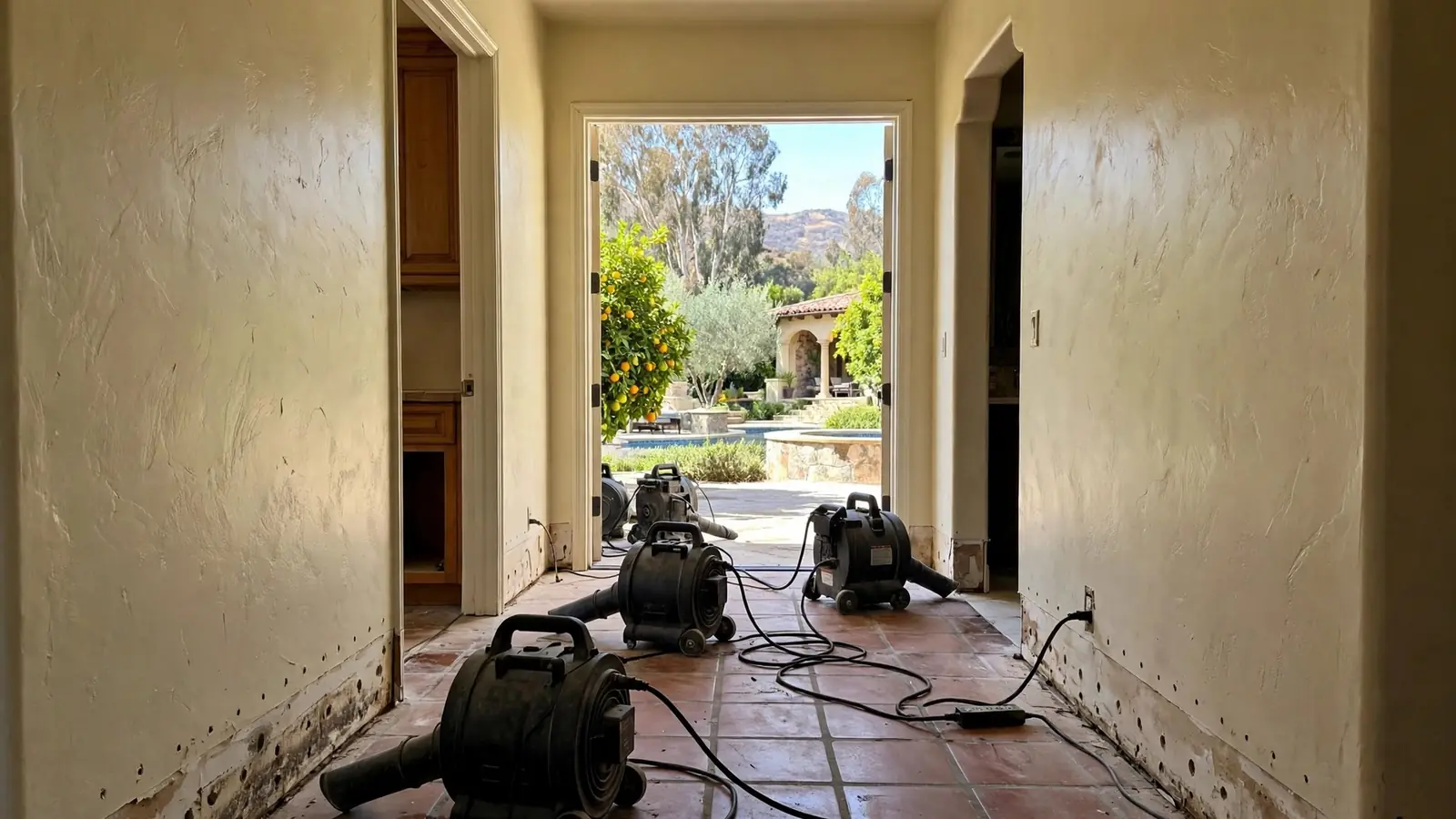
Key facts: Whispering Palms
- Whispering Palms is a golf-course community within Rancho Santa Fe's 92091 ZIP code with condominiums, townhomes and single-family homes.
- In attached housing, water often travels through shared walls, ceilings and stacked plumbing into neighboring units.
- Responsibility for repairs in condominiums is usually divided between owners and the association by the CC&Rs.
- Owners typically carry their own policy alongside the association's master policy.
- Moisture maps covering every affected unit help owners, the association and insurers work from the same facts.
In this page
- 1Whispering Palms ZIP code covered
- 2A golf community with attached homes
- 3Building features in Whispering Palms that affect water damage
- 4Common sources of water damage in Whispering Palms
- 5How a contractor should approach a Whispering Palms loss
- 6Typical responsibility in attached homes
- 7How restoration works across shared walls
- 8Working with neighbors and the association
- 9Rain, irrigation and the seasons in Whispering Palms
- 10Practical steps for owners and associations
- 11Restoration services Whispering Palms owners need most
- 12Insurance when several policies are involved
- 13Ground-floor units and slab leaks
- 14How the season affects water jobs in Whispering Palms
- 15Townhomes with private and shared elements
- 16A typical first week after a Whispering Palms leak
- 17Older buildings and materials
- 18Questions Whispering Palms owners find helpful
- 19Water heaters tucked into closets and garages
- 20Seasonal residents and empty units
- 21Musty odors that move between units
- 22Water damage in clubhouses, hallways and shared spaces
- 23What tends to leak in condos and townhomes
- 24Single-family homes along the fairways
- 25Repairs in buildings with shared finishes
- 26Whispering Palms water damage questions
Covered area
Whispering Palms ZIP code covered
Whispering Palms addresses use the Rancho Santa Fe 92091 ZIP code, which is covered by the contractor network this line connects to.
- Rancho Santa Fe ZIP 92091
About Whispering Palms
A golf community with attached homes
Whispering Palms grew up around a golf club on the lower ground near the San Dieguito River valley, and its housing is more varied than most of Rancho Santa Fe. Alongside single-family homes, it has condominium and townhome complexes where owners share walls, roofs and grounds. Many of these buildings are older than the large custom estates in nearby gated communities.
That mix creates a distinct set of water damage situations. In a detached house, a leak is one owner's problem. In a condominium building, a failed supply line in one unit can soak the ceiling of the unit below and the wall of the unit next door, and pipes in shared walls may belong to the association rather than any one owner.
Older attached buildings also have aging shared plumbing: risers, drain stacks and supply mains that serve several units. When one of these fails, several homes are affected at once.
Construction
Building features in Whispering Palms that affect water damage
Shared walls between units
Water inside a party wall reaches both units, and drying it means access from both sides.
Stacked units and shared ceilings
Upper-unit leaks show up as ceiling stains and drips in the unit below.
Common plumbing risers and stacks
Vertical pipes serving several units are often association property; a failure affects everyone on that line.
Slab-on-grade ground floors
Ground-floor units on slabs can have slab leaks that spread under flooring.
Fairway-facing patios
Patios and doors facing the course can take in runoff and irrigation spray.
Shared roofs
Roof leaks in attached buildings can affect several top-floor units.
How leaks start here
Common sources of water damage in Whispering Palms
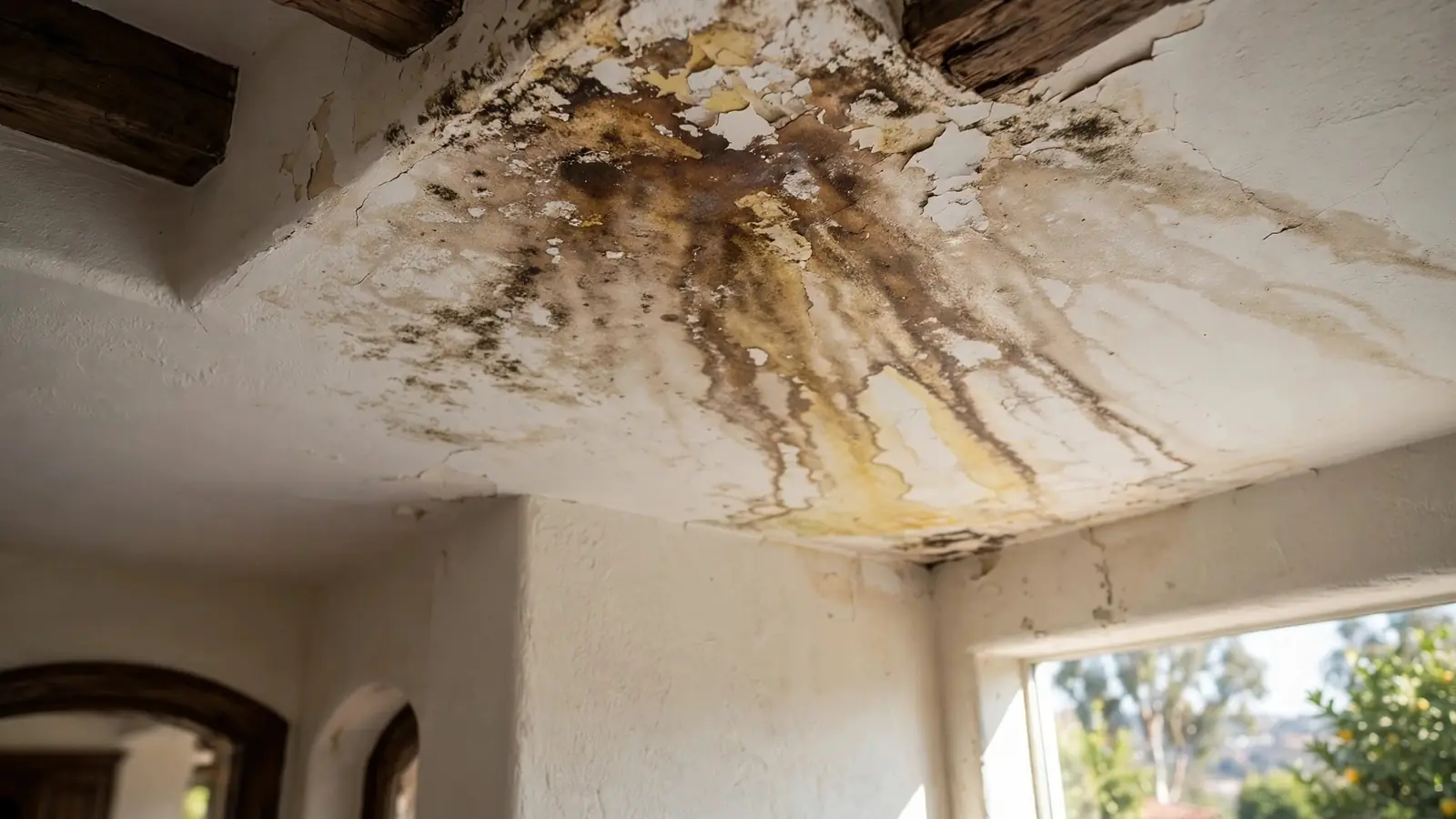
Inside units, the usual suspects are toilet supply lines, washing machine hoses, dishwasher connections, water heaters and shower pans. In older buildings, original or early replacement plumbing is more likely to fail, and in shared buildings, a failure in one unit affects others.
Building-wide systems are another source. Drain stacks can clog and back up into the lowest units. Supply risers can develop leaks inside walls. Roof drains and gutters can overflow in storms and send water into top-floor units or down exterior walls.
Outside, the golf course and landscaping bring irrigation close to buildings. Misaligned sprinklers and broken lines can wet walls and patios. In heavy rain, lower ground near the valley can collect runoff.
Assessment
How a contractor should approach a Whispering Palms loss
- 1
Identify every affected unit
The contractor checks units above, below and beside the source, not just the one that called.
- 2
Find the source and its owner
Is the failed pipe or fixture inside a unit, or part of the shared building system? That decides who is responsible.
- 3
Coordinate access
Drying shared walls and ceilings needs access from neighboring units; the association often helps arrange it.
- 4
Map moisture in each unit
Separate moisture maps for each unit and common area keep the record clear.
- 5
Classify the water
A clean supply leak, a washer overflow and a drain stack backup are different categories with different cleanup.
- 6
Share documentation
Each owner, the association and the insurers receive the same photos and readings.
Who handles what
Typical responsibility in attached homes
| Item | Often responsible | Notes |
|---|---|---|
| Fixtures and appliances inside a unit | Unit owner | Toilets, sinks, washers, water heaters |
| Supply risers and drain stacks | Association | Shared vertical plumbing |
| Roofs and exterior walls | Association | Varies by complex |
| Interior finishes in a unit | Unit owner | Flooring, cabinets, paint; check CC&Rs |
| Damage from a neighbor's fixture | Depends on cause | Insurers often settle between themselves |
| Common areas and grounds | Association | Hallways, landscaping, irrigation |
Neighbors
Working with neighbors and the association
In attached housing, a water problem almost always involves someone else. Early communication with neighbors and the association avoids misunderstandings and speeds drying.
If you find water coming from above or next door, knock on the neighbor's door and contact the association or property manager. If your unit is the source, tell your neighbors right away.
- Tell neighbors above, below and beside you
- Contact the association or property manager
- Photograph damage in each unit
- Notify your own insurer

Seasonal factors
Rain, irrigation and the seasons in Whispering Palms
Storms in the rainy season, usually from late fall to early spring, test shared roofs, gutters and drains. Top-floor units are most exposed to roof leaks, and ground-floor units to runoff and drain backups.
During the dry months, irrigation of the course and grounds runs hard. Sprinklers that hit walls and broken lines near buildings are more common. Plumbing failures inside units happen year-round.
Prevention
Practical steps for owners and associations
- Replace rubber washer and toilet supply hoses with braided lines
- Fit leak sensors under sinks, near water heaters and behind washers
- Know where your unit's shutoff valve is and whether it works
- Ask the association about the age and inspection of shared risers and stacks
- Report irrigation spraying walls or patios to the association
- Leave a key or contact with a neighbor or the association when traveling
Services
Restoration services Whispering Palms owners need most
Water damage cleanup
Supply line and appliance leaks that reach neighboring units.
Sewage cleanup
Drain stack backups into ground-floor units, handled as Category 3.
Mitigation and drying
Drying shared walls and ceilings from both sides with documented readings.
Commercial water damage
Association-managed buildings and common areas.
Insurance in attached homes
Insurance when several policies are involved
In a condominium, the association usually holds a master policy covering the building structure and common areas, while each owner holds a policy for their unit's interior and belongings. What is covered by which policy depends on the CC&Rs and the policies themselves.
When water crosses from one unit to another, insurers may work out responsibility between themselves. Your job is to report the loss promptly to your own insurer, document the damage in your unit and share information with the association. Our guide to working with your insurance adjuster has more.
The California Department of Insurance offers consumer help if you have questions about how a claim is being handled. [2]
Ground-floor units
Ground-floor units and slab leaks
Ground-floor units sit on slabs, and supply lines may run beneath them. A slab leak can wet flooring across a unit without any visible source, and it may also affect a neighboring ground-floor unit. Warm spots on the floor, sounds of running water and rising water bills are clues.
Because the line may serve more than one unit or be part of the building system, the association should be told about a suspected slab leak. A leak detection specialist can locate it before repairs.
Talk to a local contractor
Questions about whispering palms?
One call connects you with an independent water damage restoration contractor who serves Rancho Santa Fe.
Seasonal timing
How the season affects water jobs in Whispering Palms
| Season | Common sources | Most affected units |
|---|---|---|
| Late fall to spring | Roof leaks, gutters, runoff | Top-floor and ground-floor units |
| Summer | Irrigation, AC condensate | Units facing lawns and the course |
| Year-round | Supply lines, appliances, water heaters | Units below and beside the source |
| Busy holidays | Drain stack overload with guests | Lowest units on a shared stack |
Week one
A typical first week after a Whispering Palms leak
- 1
Day one
Source stopped; neighbors and association informed; extraction in each affected unit; moisture mapped.
- 2
Day two
Access arranged to neighboring units; ceilings and walls opened where needed.
- 3
Days three to five
Drying in all affected units; monitoring visits record readings for each.
- 4
Days five to seven
Most areas reach dry standard; equipment removed; documentation shared.
- 5
After drying
Repairs scheduled according to who is responsible for each item.
Older buildings
Older buildings and materials
Some buildings in Whispering Palms are older and may contain materials that need testing before demolition, such as ceiling texture, flooring or drywall compound with asbestos, or lead-based paint in buildings from before 1978. A careful contractor will raise this before cutting.
Older shared plumbing is also more likely to fail. If your building has had several leaks, it may be worth the association commissioning a plumbing inspection.
On your call
Questions Whispering Palms owners find helpful
- Will you check neighboring units for water?
- How do you dry a shared wall?
- Will you keep separate records for each unit?
- Can you work with the association or property manager?
- How do you handle a drain stack backup?
- What is your California contractor license number?
Water heaters in closets
Water heaters tucked into closets and garages
In condominiums and townhomes, water heaters are often installed in interior closets, small utility rooms or attached garages rather than in a separate mechanical room. When one fails, water spreads quickly into hallways and bedrooms, and in upper units it goes straight into the floor below. Tanks that have reached the end of their service life tend to leak from the bottom, sometimes slowly for weeks before a sudden failure.
A drain pan piped to a safe location, a leak sensor and a check of the tank's age go a long way. Most tanks carry a manufacture date on the label. If yours is old and showing rust at the base or around fittings, plan its replacement before it decides for you. Hard water from local supplies leaves sediment that shortens tank life, so periodic flushing helps.
Away for the season
Seasonal residents and empty units
Some owners in Whispering Palms spend part of the year elsewhere, which means units can sit empty for weeks or months. An empty unit is where small leaks become large ones, both for the owner and for neighbors below and beside. The longer water runs unseen, the more likely the job includes mold remediation as well as drying.
Before leaving, turn off the water supply to the unit if the plumbing allows it, set the water heater to vacation mode, and leave a key or contact details with the association or a trusted neighbor. Leak sensors that send alerts to a phone, paired with an automatic shutoff valve, give peace of mind to everyone in the building.
Odor and mold
Musty odors that move between units
A musty smell that shows up in one unit sometimes starts in another. Shared walls and ceiling cavities connect units, and moisture or mold in a neighbor's wall can affect the air on your side. If you notice a persistent odor with no source in your unit, mention it to the association and your neighbors.
A moisture survey of the shared wall or ceiling, from both sides if possible, usually finds the cause. If mold is found, remediation follows containment practices and may need to be coordinated across units.
Common sources
What tends to leak in condos and townhomes
| Source | Where it usually goes | Quick check |
|---|---|---|
| Toilet supply line | Bathroom floor, ceiling below | Braided line, valve that turns |
| Washer hoses | Laundry closet, floor below, hallway | Hose age, drain pan |
| Water heater | Closet or garage, adjacent rooms | Tank age, rust at base |
| Shower pan or grout | Ceiling below, wall beside | Loose tiles, cracked grout |
| Drain stack | Lowest units on the stack | Several slow drains at once |
Golf-side homes
Single-family homes along the fairways
Not every Whispering Palms home is attached. Single-family homes along the course have their own roofs, plumbing and yards, and their water risks look more like those of detached homes elsewhere in Rancho Santa Fe: supply line failures, water heaters, slab leaks and storm runoff toward patios. What sets them apart is the course next door. Fairway irrigation, drainage swales and the lower ground toward the valley all influence how water moves around the house.
If water keeps appearing at a wall or patio facing the course, look at where irrigation spray and runoff go. Photograph the pattern during watering and after rain, and share it with the contractor and, if the source is beyond your lot, with whoever maintains the course or common grounds.
FAQ
Whispering Palms water damage questions
Water is coming through my ceiling from the unit above. What do I do?
Contact your neighbor and the association right away, photograph the damage, and call for help. The source must be stopped in the unit above.
Who is responsible for a leak in a shared wall?
It depends on whether the failed pipe is part of a unit or the building system, and on the CC&Rs. The association can help clarify.
Does the contractor need access to my neighbor's unit?
Often, to dry shared walls and ceilings properly. The association can help arrange it.
Is a drain stack backup sewage?
Yes. Water from a drain stack is treated as Category 3 and cleaned and disinfected accordingly.
Can I get help at night?
Yes. Whether the leak is in your unit or the one above, calls are taken around the clock by an independent contractor.
Does the HOA's insurance cover my unit?
The master policy usually covers the structure and common areas; your own policy covers the interior and belongings. Check both.
How long will drying take?
Most clean-water jobs take several days. Drying from both sides of shared walls helps.
My neighbor is away and water is coming from their unit. What now?
Contact the association or property manager, who may have emergency access or a contact for the owner. If water is still flowing, the building's main or riser shutoff may need to be closed by someone authorized to do it.
Can I choose my own contractor if the association hires one?
For work inside your unit that you are responsible for, usually yes. For shared elements, the association typically chooses. Clarify who is handling which part.
Will drying equipment be loud for my neighbors?
Air movers and dehumidifiers are noticeable, especially in shared walls. Let neighbors know how long equipment will run and that it needs to stay on overnight.
Do I need to move out while my unit dries?
Usually not. Most owners stay while equipment runs, though you may prefer to sleep away from the noisiest room for a few nights.
Should I tell my neighbors?
Yes. Water rarely stays in one unit, and early warning helps everyone.
Sources and citations
- [1]IICRC S500 Standard for Water Damage Restoration
- [2]California Department of Insurance
- [3]U.S. EPA: Mold cleanup in your home
- [4]California Contractors State License Board
- [5]San Diego County Planning & Development Services
- [6]Santa Fe Irrigation District
- [7]National Weather Service San Diego
- [8]FEMA: Flood maps
- [9]U.S. EPA: Protect your family from asbestos